AI is reshaping hiring. Make it inclusive.

It’s no secret that attracting, hiring and retaining top talent is a challenge for employers. But it’s not something you need to tackle alone.

Isn’t it time you take a closer look at how an RPO partner can help your organisation optimise its hiring power in an increasingly competitive market?

Think about it… are you:

  • Building a talent pipeline to fulfil today’s talent needs as well as what you might need in the future?

  • Developing and communicating an authentic employee value proposition?

  • Embedding DEI at every level of your organisation?

  • Streamlining your recruitment process with the latest and greatest technology?

Take a closer look at the key ways in which an RPO partner can help your organisation optimise its hiring power in an increasingly competitive market.


The pharma and life sciences industry faces a major talent shortage—currently 35% below what’s needed, with over 87,000 open roles in the US alone. Talent leaders need to think differently about how they approach talent, and take some specific actions to close the skills gap.

This whitepaper reveals why the gap persists and offers four actionable strategies:

  • Boost Internal Mobility: Unlock your workforce’s potential with better career pathways and job rotations.

  • Focus on Skills, Not Just Credentials: Expand your talent pool and hire smarter with skills-based recruitment.

  • Adopt a Flexible Talent Mix: Blend permanent, contract, and gig workers for agility and resilience.

  • Use Data-Driven Insights: Leverage talent intelligence to target skill gaps and optimize hiring.

Download the full paper for practical solutions to attract, develop, and retain the talent your organization needs to thrive.

We’re in a unique moment for talent acquisition, facing challenges unlike any before. But here’s the thing: within these challenges lie incredible opportunities.

Our latest report, Future-Proofing Talent Acquisition for 2025 and Beyond, dives into this head-on.

From the latest trends like integrating AI to actionable strategies and insights to address challenges like talent and skills shortages, we’ve packed this report with everything you need to transform your talent acquisition approach.

Ready to make these challenges your opportunities?

Download the report now and take the first step towards future-proofing your talent strategy.

Wondering whether Recruitment Process Outsourcing might be the game changer you need to build a really efficient and effective talent acquisition team?

In today’s fast-paced business environment, organizations need to do more with less. They require a strategic, holistic, and innovative approach to talent acquisition while remaining agile in their operations. Thankfully, this is not a challenge that organizations need to tackle alone.

Discover the power of Recruitment Process Outsourcing (RPO) with our comprehensive guide that includes:

  • Understanding RPO: Learn how RPO works and why it’s becoming the go-to solution for modern businesses.

  • Types of RPO Models: Explore the various RPO models available and find the one that aligns best with your organization’s needs and goals.

  • Services and Benefits: Dive into the multitude of services and transformative benefits the right partner can bring to your recruitment efforts.

Download the guide and discover why outsourcing recruitment to an RPO partner is the game-changer your business needs.

Matching answers. Generic content. ‘Samey’ cover letters. Written assessments you’ve seen before. The involvement of Generative AI in your Early Careers candidates’ applications is probably hard to miss. It’s everywhere.

As more and more candidates are using Generative AI to complete their assessments, there are decisions to make about how you should respond. Should you condemn Generative AI and try and limit its use, affecting your candidate pool? Or can you embrace its capabilities, as your candidates are doing, and evolve your hiring process?

  • Technology as a competitive lever
  • Diversity, equity, and inclusion (DEI) remains relevant
  • Balancing efficiency and recruitment strategy

Demand for hourly talent continues to outpace supply. What can organizations do to gain a competitive advantage? A seamless recruitment experience is key and this requires the perfect combination of technology, people and process.

Our guide to volume recruitment explores:

  • How to use technology in the right way to supercharge your volume recruitment
  • The importance of a  people-first approach and how to balance tech and touch
  • Key things to think about when optimizing your volume recruitment process

A perennial challenge faced by HR and Talent Acquisition (TA) leaders worldwide is that of recruitment budgeting and funding.

Funding for the hiring of talent may not be a critical issue for business, however the hiring of that talent certainly is.

Effective talent acquisition functions require a funding model that allows them to flex and scale in order to meet business needs.

In this paper AMS explores the various funding models available to businesses and shares its significant experience of the advantages and disadvantages of each.

We live in a world driven by technological transformation. Pervasive new technologies have touched all industries and businesses.

Now, the talent landscape has been propelled into a digital sphere, whether that’s automated CV sifting or conversational AI driven hiring processes. While digitalisation has been welcomed with open arms, organizations that fail to embrace talent technology will be placed at a crosshair between their digitally nimble competitors.

Join us as we delve deep into some of the most common myths about talent technology – how tech-enabled tools, when utilised accurately and embedded properly, can uplift your talent acquisition strategy to allow for better, faster, and more dynamic hiring decisions.

Discover key insights from talent industry experts, thought leaders, and academics.

Join us as we uncover the truth behind 5 common talent technology myths:

Myth 1:
Talent technology will replace the need for recruiters and sources 

Myth 2:
Once launched, technology can just look after itself 

Myth 3:
Today’s workforce is more tech enabled

Myth 4:
I’ll lose my TA employees to digital transformation

Myth 5:
Operationalizing AI technology in my organization will be straight forward

Conclusion

As the world navigates through unprecedented times, talent challenges are threatening to thwart organizations’ future plans and potential. Amid the growing talent challenges, contingent talent or the extended workforce is emerging as the next frontier for disruption and innovation.

We partnered with Everest Group to explore how organizations can build a practical and successful direct sourcing solution.

In this paper, we explore not only the basics of direct sourcing, but also look at:

  • Benefits and components of a successful program
  • Various direct sourcing models prevalent in the market
  • Considerations and implications for organizations as they create a roadmap for direct sourcing adoption.


Produced in partnership with

The competition for great talent is intensifying the pressure on Talent Acquisition (TA) teams – many of which are already trying to keep up with reduced resources after a couple tumultuous years.  As organizations rebuild, rebound and expand they must scale their workforce fast to capitalize on new opportunities – but, many don’t have the capacity or capability to keep up.

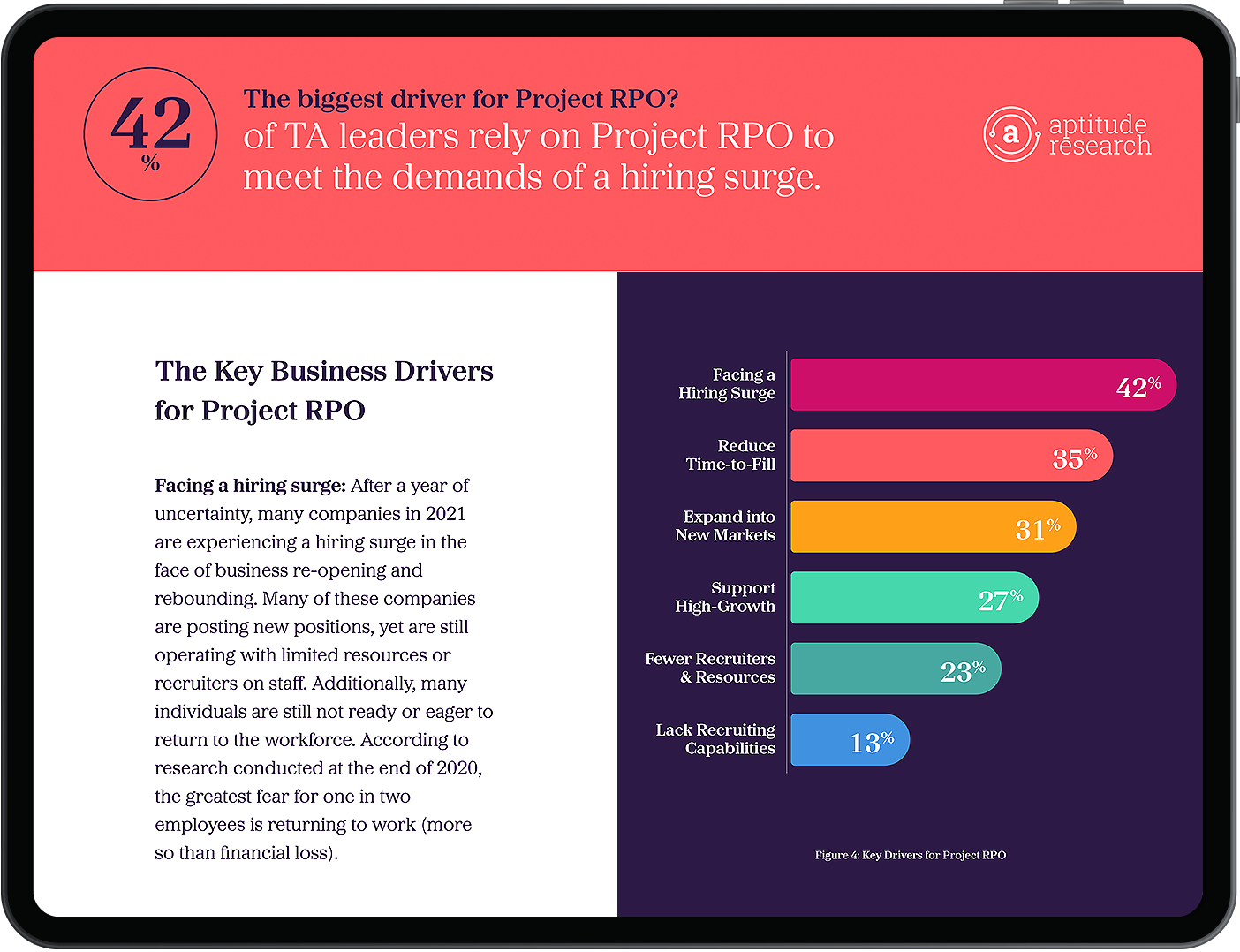
There’s a misperception that RPO is only for long-term, complex talent challenges.  So, we partnered with Madeline Laurano, founder of Aptitude Research, to explore when and why hundreds of HR and talent leaders lean into recruitment outsourcing on a project basis to fill their TA capability and capacity gaps – and, the long-term value Project RPO drives for their in-house teams.

 If you’re wondering how Project RPO could lend a helping hand to your TA team, read the digital paper to understand: 

  • How is the current state of talent acquisition impacting how we recruit? 
  • How is Project RPO different from a traditional RPO engagement? 
  • What are the key business drivers and investment criteria? 
  • What additional outcomes and business impact can your in-house team realize?