Front office roles – investment bankers, traders, sales leads, client relationship managers – have always been the lifeblood of financial services. Recruiting them has historically relied on long hours, manual networking and time-consuming market mapping.
But by 2030, the recruiter’s role will look radically different. With agentic AI acting as a true co-pilot, recruiters are no longer buried in resumes and repetitive tasks. Instead they are strategic talent architects, blending data-driven insights with human judgment.
The recruiter becomes less of an operator and more of a talent strategist and relationship builder, while their AI “co-recruiter” autonomously handles sourcing, screening, and engagement at scale.
Here’s how a day in the life of a front office recruiter of the future might unfold:
From Operator to Strategic Partner
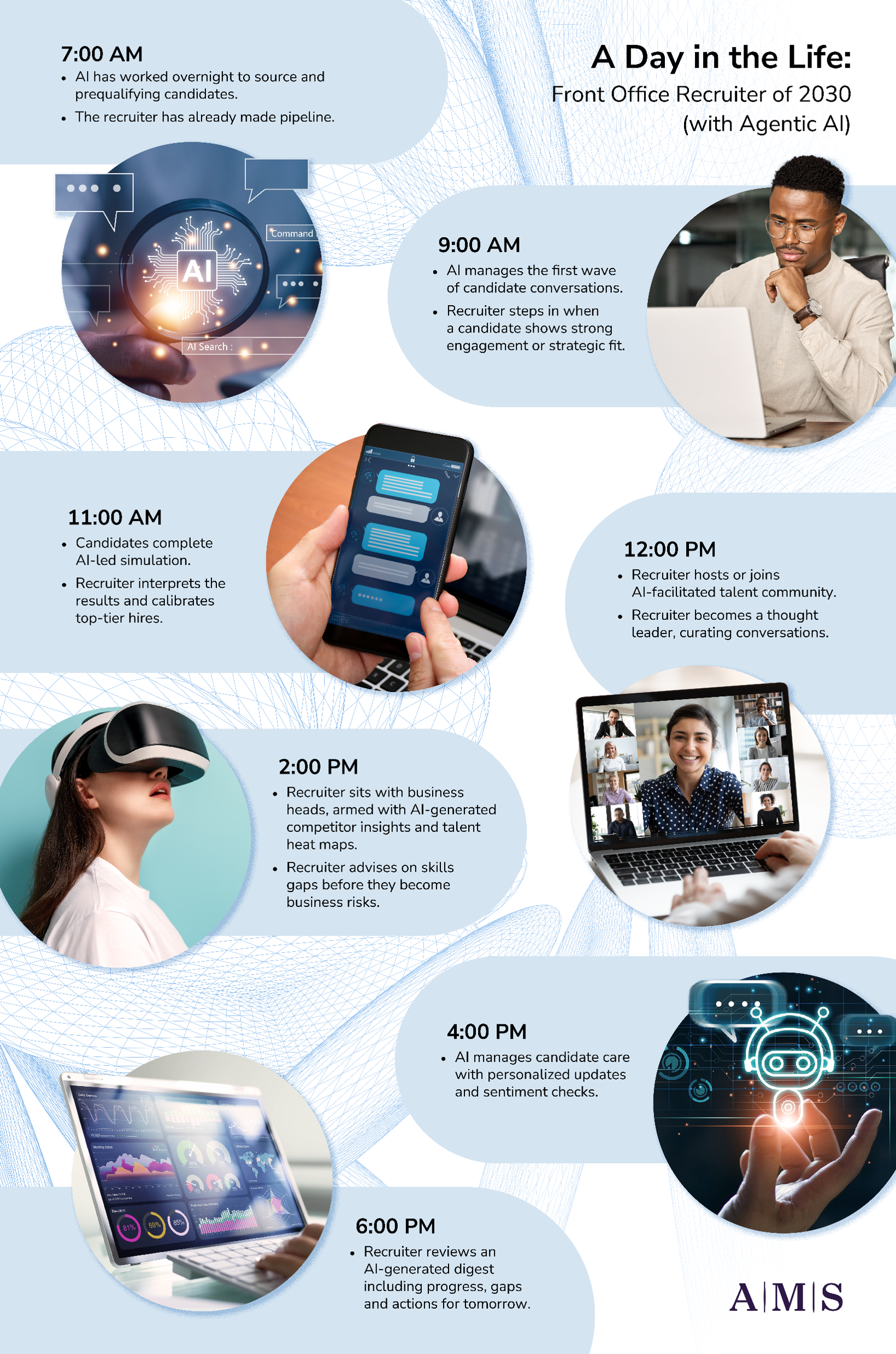
- Overnight talent scouting: Agentic AI scouts global databases and maps out target organizations while the recruiter sleeps, prequalifying top candidates and even initiating first outreach. By 7am the recruiter has a ready-made pipeline
- Human + AI candidate engagement: At 9am the AI manages the first wave candidate conversations, answering FAQs and filtering interest levels. The recruiter only steps in when a candidate shows strong engagement or strategic fit.
- Immersive assessments, AI-run: By mid-morning, candidates are completing AI-led simulations of trading floors or client pitches. Recruiters only spend time on interpreting the results and calibrating for top-tier hires.
- Building communities, not just pipelines: Lunch is no longer about cold calls – it’s about hosting or joining AI-facilitated talent communities. Recruiters become thought leaders, curating conversations around market shifts and future skills.
- Strategy at the leadership table: In the afternoon, recruiters sit alongside business heads, armed with AI-generated competitor insights and talent heat maps. They advise on skills gaps before they become business risks.
- Seamless candidate experience: AI manages candidate care with personalized updates and sentiment checks. Recruiters step in only when a human touch can save or strengthen a relationship.
- End of day intelligence: By 6pm, the recruiter reviews an AI-generated digest – progress made, gaps identified and recommended actions for tomorrow.
Why This matters for leaders
The front office recruiter of the future is:
- Data-driven: anticipating business needs before they arise.
- Efficient: AI handles scale, humans focus on strategy and relationships
- Influential: not just filling seats but shaping workforce strategy.
For executives, this means faster access to top talent, reduced hiring risks, and a more competitive workforce – all while elevating recruiters from administrators to strategic partners.
How can TA Leaders prepare now?
Forward looking TA leaders can start building the foundations today with the following:
- Invest in talent intelligence – build the muscle now for market mapping, competitor insights and skills heat maps. Even without Agentic AI, TA teams can start collecting and interpreting data to advise business leaders more strategically.
- Pilot AI in low risk areas – stat with AI-led sourcing, screening or scheduling allowing recruiters to build confidence in AI as a partner not as a replacement.
- Use early pilots to shape policies on ethics, bias and candidate experience.
- Shift recruiter skills to act as talent advisors and community builders focusing on data literacy, relationship building and influencing senior stakeholders.
- Work with HR, business heads and technology teams now to align on future needs. TA can’t sit in isolation – recruiters of the future will influence workforce strategy, not just hiring.
The key is to start small experiments, build recruiter skills and reframe TA’s role from filling jobs to shaping the business.