


Introduction
Global enterprises today are under increasing pressure to accelerate digital transformation while maintaining cost efficiency and access to high-quality talent. India has become a clear front-runner for companies looking to expand global operations efficiently.
As of FY2024, India hosts approximately 1,700 GCCs, employing over 1.9 million professionals. These centers have collectively generated $64.6 billion in revenue, marking a significant 40% increase from the previous fiscal year. Looking ahead, the GCC market in India is projected to grow to between $99 billion and $105 billion by 2030, with the number of centers expected to reach 2,100–2,200 and employment rising to 2.5–2.8 million individuals.
With its unique mix of digital maturity, cost efficiency, and world-class talent, India has evolved from a support location to a global engine for enterprise innovation.
So where does AMS fit into this picture? This blog explores how we help companies unlock India’s full potential through tailored GCC talent solutions.
What Makes India Strategic for GCC Setup and Scale
For companies launching GCCs, India is no longer just a low-cost location, but it’s a hub for digital transformation and business resilience.
From Fortune 500 companies to high-growth disruptors, organizations are increasingly prioritizing India for setting up and expanding their Global Capability Centers (GCCs).
India offers an unbeatable trifecta that continues to attract global firms seeking to build or scale their Global Capability Centers:
- STEM Talent: India’s higher education system continues to produce a vast pool of technically skilled professionals each year. For the academic year 2024–25, the approved intake for undergraduate engineering and technology programs was approximately 1.49 million (14.90 lakh). It’s a testament in itself to the strength and sustainability of India’s STEM talent pipeline. India continues to produce a very large number of engineering graduates.
- Cost Arbitrage: Labor arbitrage remains a major draw, especially for technical and back-office functions. This translates into real and sustained cost savings. Labor and operating costs in India remain notably lower than in many Western and nearshore markets. For instance, the average cost of living in India in April 2025 is estimated at around $700/month for a four-person family, significantly lower than the ~$4,200/month in the USA or ~$3,200/month in Germany.
- Established Delivery Ecosystems: Major cities like Bengaluru, Hyderabad, Pune, and Chennai host hundreds of mature GCCs and offer a robust digital and operational ecosystem. Beyond traditional Tier-1 cities like Bengaluru, Mumbai, and Delhi NCR, Tier-2 cities such as Pune, Hyderabad, Chennai, Coimbatore, and Visakhapatnam are increasingly emerging as dynamic talent hubs. These cities are building capabilities in AI, data science, cloud computing, and cybersecurity. This decentralization is creating distributed innovation hubs that rival traditional metro cities in talent depth and cost efficiency.
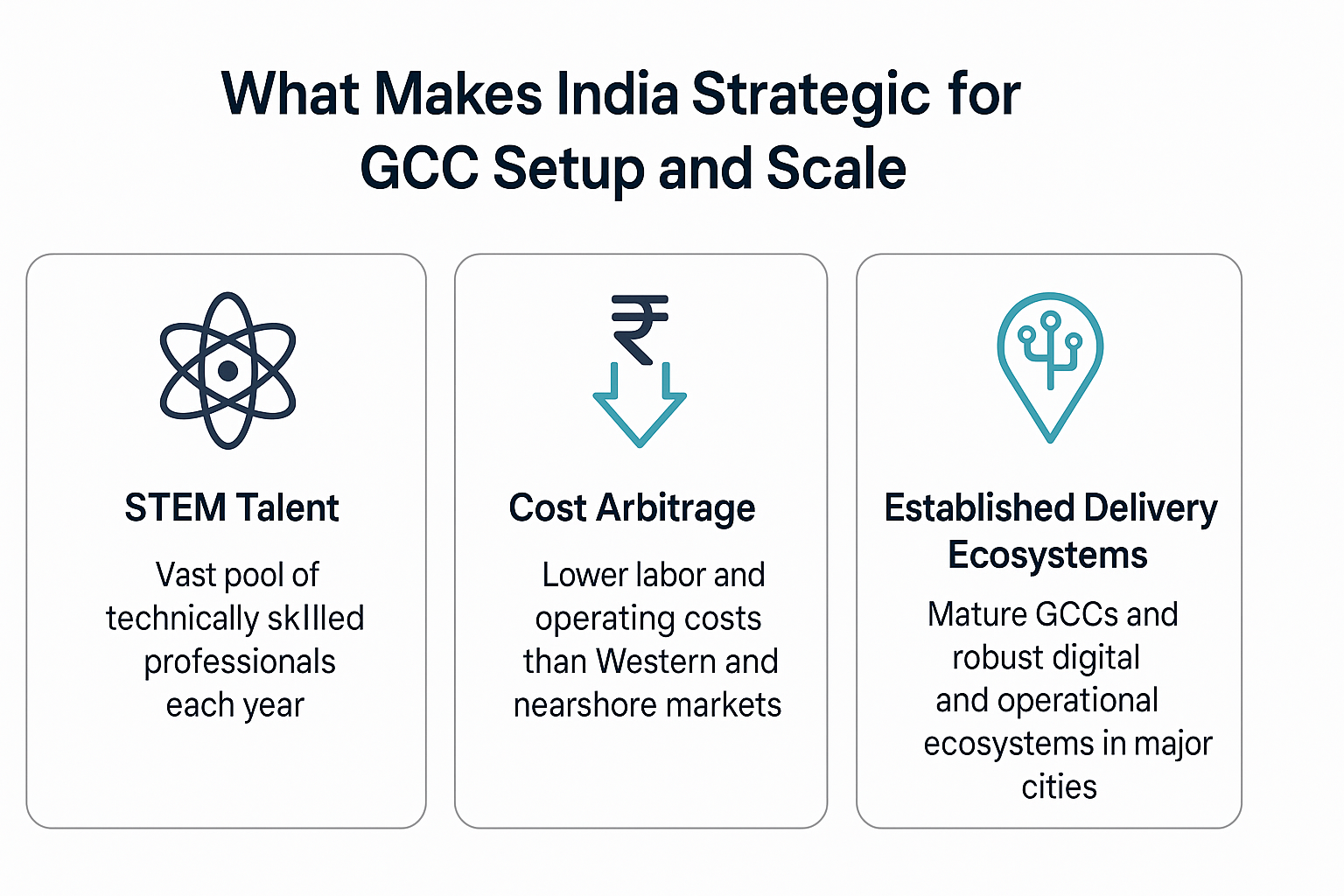
Alt Text: An infographic showing why India is strategic for GCC setup and scale, with key benefits like STEM talent, low cost, and delivery hubs across Indian cities.
Whether your company is setting up an offshore development center, launching a captive center, or shifting shared services outsourcing to India, the country now supports advanced R&D, AI, cybersecurity, and global finance with all under a resilient global delivery model.
How AMS Fuels Your India GCC Talent Needs
At AMS, Recruitment Process Outsourcing (RPO) is at the heart of our solutions. We partner with enterprises to build, scale, and optimize hiring operations that are agile, high-impact, and tailored to India’s unique talent landscape.
Our RPO services encompass:
- Enterprise RPO: Comprehensive, long-term recruitment solutions that manage the entire hiring lifecycle, from workforce planning to onboarding.
- On-demand RPO: Flexible, project-based recruitment support to address immediate hiring needs without long-term commitments.
- Hybrid RPO: A combination of Enterprise and On-demand RPO, offering scalability and adaptability to changing business requirements.
Beyond RPO, AMS provides specialized services to support GCCs in India:
- Executive and Leadership Hiring: Track record of hiring for critical roles such as country heads, GCC MDs, and senior functional leaders across IT, finance, and R&D.
- Volume and Niche Tech Hiring: Deep sourcing expertise in domains like AI/ML, cloud, data engineering, cybersecurity, and embedded systems.
- Campus and Early Careers Hiring: Nationwide university engagement and program management, including offer-to-join conversion strategies for India’s top engineering and business schools.
- Contract and Flexible Hiring: Agile, compliant workforce models for skill-based, project-based, or surge hiring needs.
- Diversity and Inclusive Hiring: Data-led strategies to attract diverse talent across gender, region, and underrepresented communities.
- Employer Branding and EVP Design: Custom talent messaging and employer value proposition design for India market entry or regional scaling—especially vital in cities like Bengaluru, Pune, Hyderabad, and NCR.
By integrating these services, AMS ensures that your GCC in India is not only operationally efficient but also strategically positioned for long-term success.
If we talk about our success, when a global tech company needed to hire over 5,000 junior-to-mid-level specialists in India over two years, we at AMS became their trusted partner.
We launched a pilot program that:
- Processed 800 candidates in just 3 months
- Delivered 134 high-quality offers
- Saved 1,667 person-hours through streamlined recruitment coordination
- Achieved a 17.5% offer conversion rate, compared to their previous 2% rate
This is just one example of how we de-risk hiring and accelerate execution for GCCs.
Accelerating Your GCC: Speed, Scale, and Strategic Growth
Speed is a vital part when launching a GCC in India. With AMS, you gain a partner who can mobilize rapidly, helping you achieve:
- Pre-built hiring infrastructure across 15+ Indian cities
- Market-tested sourcing playbooks and assessment frameworks
- Rapid ramp-up support tailored to your GCC lifecycle
- Talent strategy and location advisory grounded in local realities and global goals
If you’re setting up or expanding a shared services center, we help ensure your teams are staffed quickly, compliantly, and with the right skill mix to support global functions.
Today’s GCCs in India go beyond basic transactional support. Global companies are:
- Consolidating finance shared services and procurement shared services functions for cost and efficiency
- Setting up R&D global centers focused on AI, cloud, and embedded systems
- Using India as a base to modernize IT operations and global analytics delivery
In such instances, AMS supports enterprises in aligning talent acquisition with these evolving GCC functions, ensuring your teams are not only staffed, but strategically structured for long-term impact.
Nearshore vs Offshore: Why India Wins Long-Term
While nearshore locations offer geographic proximity, India continues to lead in scale, quality, and maturity. Many enterprises are moving beyond outsourcing to adopt Global Business Services (GBS) models. These centralized delivery setups consolidate finance, procurement, analytics, and IT under one global structure.
For organizations evaluating nearshore vs offshore India options, the long-term benefits of offshoring to India remain unmatched:
- Greater labor pool depth and diversity
- Sophisticated delivery models
- Proven success in shared services outsourcing
Against this backdrop, India has emerged as the strategic epicenter for Global Capability Centers (GCCs). Whether it’s technology development, shared services, or innovation hubs, India offers the speed, scale, and talent excellence required to drive enterprise transformation.
Your Partner for Global Delivery, Local Execution in India
At AMS, with over 28 years of RPO leadership, we don’t just advise; we execute. Our India-based global delivery model is built to deliver high performance with measurable cost efficiency. In India, we bring:
- 1,200+ delivery experts across major talent hubs
- On-the-ground recruiters and sourcing specialists with deep market insights
- Support for compliance, labor laws, and headcount planning
- Digital enablement and technology partnerships that make hiring smarter
Whether you're planning a new GCC or scaling an existing one, AMS gives you the executional rigor and strategic clarity to make your investment count.
Build with AMS, Build for the Future
India’s GCC ecosystem is mature, tech-driven, and talent-rich. But the speed and success of your setup depends on how well you navigate local hiring, location dynamics, and operational scaling.
AMS has done this for tech, pharma, finance, and industrial firms. Let’s talk if you’re exploring or expanding a GCC setup in India. We’ll show you what’s possible and help you make it real.
Reach out to learn more about our GCC readiness workshops and location strategy advisory.