
Most Talent Acquisition (TA) leaders know they need to evolve. The harder question is understanding what is truly holding progress back.
In practice, the challenge is not just capability; it’s that organizations are starting from very different points. For some, the barrier is legacy process. For others, fragmented technology. For many, it is an operating model built for execution while the business now expects TA outcomes that show a tangible link to strategy.
Everest Group’s latest research identifies five distinct TA personas that reflect how enterprises are operating today. These are not rankings or a linear maturity ladder; they are practical snapshots of how TA functions deliver value in the real world.
In this first blog of a three-part series, we explore where organizations sit today across these personas and what this means for the future of talent acquisition.
Where organizations are today
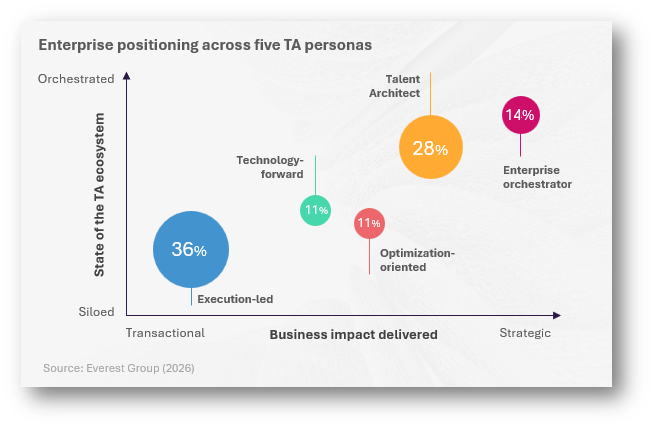
Data shows a clear skew toward delivery-focused models:
- 36% of organizations are execution-led – built primarily for speed and delivery
- 28% operate as talent architects – more strategic and insight-driven
- Only 14% function as enterprise orchestrators – fully aligned to business outcomes
The remainder sit in transitional stages:
- 11% are optimization-oriented – focused on efficiency and control
- 11% are technology-forward – enabled by automation and increasing adoption of AI
This highlights a significant gap between where most TA functions are today and where they need to be to deliver strategic impact.
In other words, while many organizations aspire to operate as strategic talent partners, the majority are still structured primarily for execution.
The five TA personas explained
1. Execution-led
Execution-led organizations represent the largest share of the market (36% of enterprises). These TA functions remain largely transactional, focused on fulfilling requisitions, controlling cost, and meeting functional level SLAs. Everest Group notes that these enterprises often face legacy structures, manual or lightly standardized processes, limited technology maturity, and partners engaged primarily for execution, not outcomes.
Key characteristics:
- Requisition-driven workflows
- High reliance on manual processes
- Limited advisory capability
- Minimal partner integration
- Technology used inconsistently across hiring types
In this persona, TA is valued for delivery, but often under-leveraged as a driver of business outcomes. The core challenge is that execution excellence, while valuable, does not meet rising expectations for agility, insight, or business alignment.
2. Talent architects
Talent architects represent the second-largest cluster (28% of enterprises) and demonstrate balanced progress across all four Ps. Everest Group notes that these enterprises have solid people capabilities, reasonably mature processes, stable platforms, and increasingly aligned partner ecosystems. In this persona, TA operates as an advisory function with consistent, data to inform decision-making.
Key characteristics:
- Even maturity across people, processes, platforms, partners
- TA embedded in workforce planning conversations
- Use of data to improve predictability and hiring quality
- Foundational readiness for orchestration, but not fully realized
These teams are moving in the right direction—but orchestration is only partial, limiting scalability and long-term impact.
3. Optimization-oriented
Optimization-oriented enterprises prioritize control, consistency, and compliance through strong process discipline. According to Everest Group, these organizations demonstrate well‑governed, standardized hiring operations, which deliver predictability and reduce variability across the enterprise. However, this strength often comes at the expense of technology maturity, advisory capability, and ecosystem integration.
Key characteristics:
- High process rigor and well-defined workflows
- Strong compliance orientation
- Limited platform enablement and analytics sophistication
- Recruiters focused on execution rather than advisory influence
- Partners primarily engaged for SLA-driven delivery
While these organizations excel in consistency and risk management, their process-centric orientation can limit agility, innovation, and their ability to support evolving talent strategies without parallel investments in people, platforms, and partners.
4. Technology-forward
Technology-forward enterprises invest aggressively in platforms, automation, and AI (enabled through solutions. However, Everest Group highlights a recurring issue: technology maturity often outpaces people capability, process consistency, and partner alignment. As a result, these organizations struggle to scale value across the enterprise.
Key characteristics:
- High platform sophistication
- Early adoption of advanced analytics or generative AI
- Uneven recruiter readiness
- Fragmented processes that limit returns
- Minimal partner orchestration
These organizations have strong potential but require substantial people and process evolution to realize it – they invest in tech without the demonstration of the ROI.
5. Enterprise-orchestrators
Enterprise – orchestrators operate TA as an integrated business capability, not a function. They demonstrate high maturity across two or more Ps and sustained progress across all four. Everest Group identifies these as the organizations most equipped for next-generation TA, delivering agile, insight-driven, outcome-led hiring.
Key characteristics:
- Strong alignment between TA strategy and business priorities
- Advanced people capabilities with true advisory influence
- Predictive analytics and unified data ecosystems
- Outcome-based partner models
- Governance that coordinates decisions across the 4Ps through a TA control tower
Only a minority of enterprises operate at this level today (14% of enterprises), highlighting the scale of opportunity still ahead.
How enterprises progress between personas
The role of constraints and imbalances
As the data shows, most organizations are not yet operating at the highest levels of maturity, largely due to imbalances across these dimensions. Everest Group emphasizes that progress is rarely linear because capability gaps in one area often slow progress everywhere else. Enterprises advance or stall based on how well they connect their model across people, process, platforms and partners. Imbalance is the most common barrier:
- Technology-forward organizations lack advisory capability.
- Process-led organizations lack insight and automation.
- Execution-led teams lack governance, platform-integration and outcome focus.
TA modernization breaks down when one P advances without reinforcement from the others.
How AMS helps enterprises progress

AMS supports enterprises by addressing constraints across all four Ps:
- People: Building strategic recruiter capability and AI literacy
- Processes: Designing adaptive workflows that integrate governance
- Platforms: Modernizing technology ecosystems with responsible AI
- Partners: Reshaping provider relationships toward shared outcomes
This integrated approach mirrors Everest’s insight that orchestration, not isolated upgrades, is what drives next-generation maturity.
Everest Group’s TA personas provide a powerful lens for understanding how enterprises approach modernization today.
Whether an organization is execution-led, process-driven, tech-forward, or approaching orchestration, each persona reflects real constraints, priorities, and opportunities. The path forward is not about matching a model but about understanding where you are, why you’re there, and what capabilities you must build next.
But understanding your current persona is only the starting point. The next challenge is how to evolve.
To move forward, organizations need a clear approach to operationalizing the 4Ps, aligning people, processes, platforms, and partners to enable meaningful transformation.
Want to understand which TA persona best reflects your operating model?
Take our interactive Which TA archetype are you? quiz and get personalized insights on your current strengths and opportunities.
Then connect with AMS to explore how we can help you accelerate progress toward next-generation TA maturity.