
Artificial intelligence is transforming HR faster than any other business function. Not in theory, but in everyday workflows. From high-volume hiring in India to global talent mobility, HR leaders are using AI in HR, AI recruitment tools and talent intelligence platforms to shorten hiring cycles, enhance candidate experience and eliminate costly manual work.
Whether you are scaling a product team in Bengaluru or stabilising operations in London, AI done right turns HR from a transactional engine into a true business accelerator. Done wrong, it amplifies bias, creates legal exposure and erodes trust across the employee lifecycle.
This guide brings a grounded, practical view of how to apply AI in HR, where it delivers real 2025 impact and how organisations can use it to build a measurable competitive edge. Let’s find out.
Why Your HR Function Needs AI Right Now
HR teams today are under more pressure than ever: hiring demands are rising, recruiter capacity is shrinking, and talent markets are shifting faster than traditional processes can keep up. AI is closing this gap by enabling faster hiring cycles, better quality of hire, lower operational workload, improved fairness, and sharper data-driven decision-making across the employee lifecycle.
And the numbers from 2025 make the case even clearer.
Gartner reports that 37% of the workforce will feel the impact of generative AI within the next two to five years. AIHR found that 76% of HR professionals fear they will fall behind if they don’t adopt AI within the next 12–18 months. Hirebee predicts that 70% of employees will interact with AI-powered tools daily by 2025. Meanwhile, KPMG estimates the global HR technology market will reach USD 42.5 billion this year, driven primarily by AI capabilities.
These insights point to one simple truth: AI in HR is no longer optional. It has become table-stakes for organisations that want to stay competitive in hiring speed, talent quality, and workforce agility.
Teams already using AI are seeing measurable benefits too. Some organisations report nearly 40% higher reactivation of past candidates, while others experience 25–45% faster time to offer for mid-senior roles. These gains are no longer limited to large enterprises. With more accessible and accurate talent intelligence platforms, even small HR teams can now achieve this level of impact.
How HR Leaders Are Using AI Today
AI For Resume Screening
Traditional resume screening relies on keyword match or manual review. Both approaches miss potential. AI changes this by analysing patterns such as achievement rate, project scale, progression speed, and skills adjacency.
Example
A fintech company in Bengaluru reduced manual screening hours by 70 percent after switching to AI scored profiles. Recruiters now validate instead of starting from scratch.
What improves
- Time to shortlist
- Diversity of pipeline
- Visibility of high potential candidates
AI For Sourcing And Rediscovery
Your most valuable candidates often already exist in your ATS. AI rediscovery tools scan past applicants, silver medalists, contractors, and alumni, map their updated skills, and match them to new roles.
Example
A global services firm found that 28 percent of their new hires in Q3 came from rediscovered profiles after implementing AI match scoring.
Why it matters
- Cuts reliance on job boards
- Reduces agency costs
- Boosts candidate quality because the system uses historical interactions
AI Powered Talent Acquisition And Personalization
Recruiters often juggle administration, scheduling, follow ups, and reporting. AI can take over these tasks with high accuracy.
What AI handles
- Interview scheduling
- Candidate nudges
- Email personalization based on work history
- Feedback summaries for hiring managers
Example
A consumer tech brand reduced recruiter workload by 32 percent by adopting automated scheduling and personalized outreach. This freed recruiters for high impact conversations.
Predictive Analytics For HR
Predictive models identify early signs of turnover, performance risk, or skill shortages.
Use cases
- Forecast attrition for critical teams
- Model future workforce demand
- Predict likelihood of offer acceptance
- Estimate hiring needs by region
Example
A logistics company used predictive analytics to anticipate seasonal hiring spikes in Pune and Chennai. Their hiring lead time dropped from 26 days to 14 days.
AI Automation Across HR Operations
Automation saves both time and cost. Several HR teams now use AI for process flows such as onboarding, training reminders, policy queries, and document collection.
Savings often include:
- About 45 percent reduction in HR service desk tickets
- Up to 70 percent reduction in manual onboarding touchpoints
- More consistent employee communication across time zones
Understanding the Types of AI in HR
To select tools wisely, you should know the different flavors of AI and what they deliver.
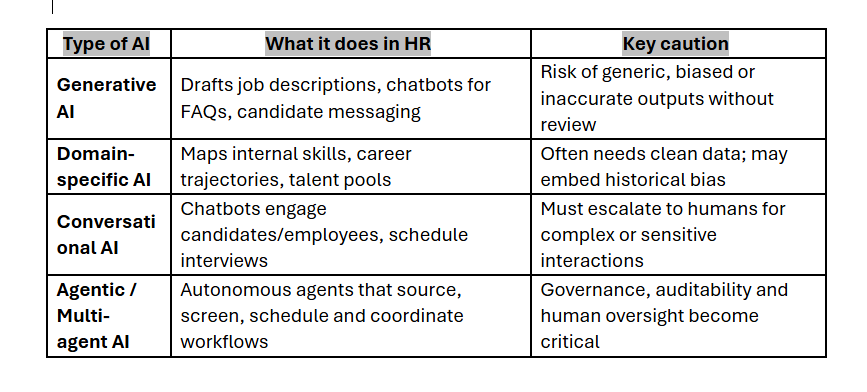
Reports say that 2025 is the year of agentic AI in HR; 47 % of executives believe rethinking talent strategy around AI will deliver ROI. Mercer
Legal, Security & Governance: The Non-Negotiables
AI in HR touches hiring, pay, movement, development. These are high-stakes decisions.
Legal & ethical:
- Regular bias and fairness audits.
- Documented decision-logic, explainability.
- Compliance with region-specific laws (India, EU, UK).
Security:
- Encryption, role-based access.
- Vendor due-diligence: SOC 2, ISO, GDPR.
- Audit logs for key decisions.
Governance Framework:
- Clear accountability matrix (RACI).
- Human-in-the-loop checkpoints at major decision points.
- Model lifecycle management: training → validation → monitoring → rollback.
From the HR trends report: only 12 % of HR departments have integrated GenAI into workflow, underscoring the risk of rushing without governance.
How to Deploy AI in HR: A Realistic Roadmap
Assess readiness (Week 0). Audit ATS/HRIS data quality, define integration points, review process maturity.
Select pilot (Week 1). Choose a high-value, low-risk use case: e.g., candidate rediscovery or scheduling automation.
Define KPIs. Examples: time-to-first-interview, % of pipeline from rediscovered candidates, cost per hire.
Run pilot (Weeks 2–10). Monitor weekly, include human-review governance, capture learnings.
Audit before scaling (Weeks 8–10). Conduct third-party bias & security review.
Scale intentionally (Months 3–6). Expand workflow coverage, embed training & governance.
Iterate. AI deployment isn’t a one-time project. Continuously review, measure, adapt.
Organizations that adopt such structured approaches in 2025 are more likely to build sustainable competitive advantage.
Measuring ROI: What to Track
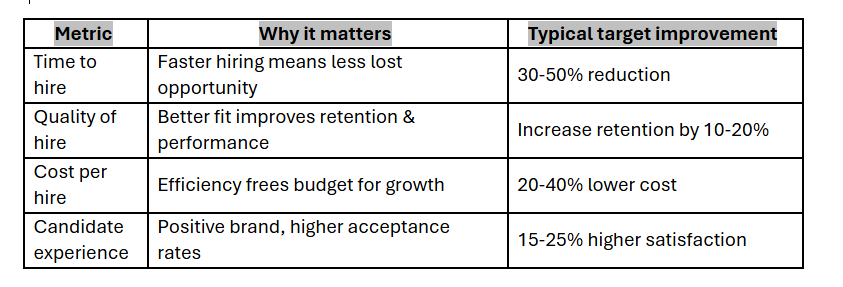
With 2025’s data showing 70 %+ of employees interacting daily with AI tools and organisations targeting full integration by year-end, the stakes are clear. Hirebee+1
Why Organizations Gain a Competitive Edge
When HR uses AI effectively, the function shifts from cost-centre to strategic driver. Here’s how:
Speed = first mover advantage in hiring critical talent.
Quality = fewer mis-hires, faster productivity.
Insights = proactive workforce planning, not reactive firefighting.
Scalability = ability to handle high-volume hiring without proportional cost increase.
Differentiation = better candidate / employee experience drives employer brand.
In 2025, when many organizations still struggle with adoption, being early and disciplined in AI use in HR can create meaningful separation in talent markets.
Final Thoughts
Adopting AI in HR is no longer an experiment. It’s now a strategic imperative in 2025. But technology without human judgment, governance and the right processes leads to risk. The winners will be HR teams that combine AI-driven speed and insight with human empathy and control.
AMS supports organizations through every stage of AI-enabled HR: from data maturity assessment, to pilot selection, to full workforce intelligence deployment. We help you move fast, stay compliant, and build a talent advantage that scales globally.
Ready to chart your AI-HR pilot?
Book a complimentary 30-minute diagnostics session with us today.