Rpo vs Traditional recruitment

TL;DR

The cost difference between RPO vs traditional recruitment becomes obvious once you look beyond the surface. Traditional hiring appears cheaper upfront, but the real spend shows up in slow cycles, agency fees, misaligned processes, and vacancy delays that quietly drain budgets. RPO flips that dynamic by offering predictable pricing, faster delivery, and structured support that eliminates waste and improves quality of hire. For organizations dealing with fluctuating demand, overextended TA teams, or competitive labor markets, RPO typically reduces total hiring costs by a significant margin. The model stabilizes them, turning hiring into a controlled, scalable, and cost-efficient function.

Many TA leaders reach the same pivotal question once hiring demand spikes or talent quality starts slipping: Is my organization spending more than it should, and where does rpo vs traditional recruitment actually make a financial difference? When budgets tighten, this comparison becomes a high-stakes, practical decision rather than a curiosity.

This is the moment buyers enter the evaluation stage. Not researching “what is RPO,” but asking, “Which model will genuinely save us money?” Understanding the difference between RPO services and a traditional recruitment process requires looking beyond surface-level fees into delays, inefficiencies, and operational waste.

Let’s break down the real differences using numbers, realistic scenarios, and cost structures that reveal where organizations lose (or gain) money without realizing it.

Why Your Recruitment Costs Keep Rising

RPO (Recruitment Process Outsourcing) nearly always yields lower long-term costs compared to traditional recruitment, particularly for mid-sized and enterprise organizations hiring at scale. Industry data and 2025 market benchmarks consistently show RPO provides 15–40% cost savings compared to in-house and agency-driven recruitment, largely through predictable pricing, reduced agency reliance, faster hiring, and integrated technology.

Imagine a mid-size technology company hiring 40 to 60 roles per quarter. The TA team handles sourcing, screening, scheduling, and reporting, often switching between on demand recruiting, recruitment agencies, and internal bandwidth.

On paper, this looks manageable.
In practice, it creates:

  • fluctuating agency fees
  • inconsistent candidate pipelines
  • slow cycles
  • duplicated work
  • burnout
  • reactive hiring
  • poor cost control

This is where evaluating agile talent acquisition, project RPO, and enterprise RPO solutions becomes not only relevant but necessary.

Because the real cost of hiring is rarely in the job ad. It sits in delays, inefficiencies, duplicated efforts, and unpredictable spend.

RPO vs Traditional Recruitment: What’s Structurally Different?

Traditional recruitment models rely on internal teams and recruitment agencies. Costs increase as hiring scales.

RPO services use a structured, data-driven, and scalable model with predictable pricing.

Below is a simple comparison showing the difference.

Comparison Table: RPO vs Traditional Recruitment

FactorTraditional Recruitment ProcessRPO Services (Including Agile RPO + Project RPO)
Cost PredictabilityLow. Fluctuates by agency, urgency, and headcount.High. Fixed, transparent pricing models tied to volume or scope.
ScalabilitySlow and manual.Fast scaling using scalable recruitment solutions.
Time to hireVariable. Dependent on recruiter availability.Faster through dedicated teams and agile hiring process.
Quality of hireInconsistent.Structured selection backed by strategic talent acquisition.
TechnologyLimited to existing internal tools.Enhanced with talent intelligence, reporting, and automation.
FlexibilityLow to moderate.High. Options like project RPO, agile RPO, and on demand recruiting.

Cost Breakdown: Where Traditional Recruitment Gets Expensive

Traditional recruitment appears cheaper at first. But hidden costs stack up.

1. Agency Fees

Most organizations underestimate agency costs because they appear in different budgets.

Example scenario:
An engineering agency charges 18 to 25 percent per hire. With 20 hires at an average salary of $110,000, the organization spends:

$396,000 to $550,000 on fees alone.

2. Delays

Every week a critical role remains open costs productivity.

If one engineering vacancy delays a project by two weeks, that can equal:
$10,000 to $25,000 in opportunity cost.

Multiply by 20 roles.

3. Fragmented Work

Internal teams often split their focus across sourcing, screening, reporting, and stakeholder management. This slows down hiring velocity.

4. Turnover From Wrong Hires

Inconsistent hiring increases misalignment and turnover risk.

Hiring the wrong person often costs 30 to 50 percent of annual salary.

Traditional hiring rarely includes structured data, intelligence, or repeatability.

Where RPO Services Reduce Costs (Even When They Look More Expensive Initially)

RPO pricing models feel higher at first glance. But RPO replaces the fragmented, duplicated costs of traditional recruitment with a predictable, controlled structure.

Here’s how organizations save money with agile RPO, project RPO, and enterprise RPO solutions.

1. Predictable Pricing Models

RPO offers transparent pricing:

  • per hire
  • cost per recruiter
  • monthly project models
  • hybrid pricing

This eliminates unpredictable agency bills.

2. Faster Hiring Cycles

Dedicated teams reduce time to hire by 20 to 40 percent. Faster hiring means lower vacancy cost.

3. Higher Talent Quality

RPO uses structured assessments, validated processes, and market intelligence. This reduces mis-hires.

4. Scalable Recruitment Solutions

When a business suddenly needs 50 hires, RPO can scale in days.
Traditional hiring cannot match this speed without expensive agency support.

5. Lower Technology Burden

Organizations avoid buying:

  • sourcing tools
  • CRM systems
  • analytics dashboards
  • talent intelligence platforms

RPO providers already include these.

Hiring Spike Without RPO vs With RPO

  1. Imagine a retail company preparing for peak season.

    Without RPO

  • Internal team overwhelmed
  • Agencies engaged late
  • Extra cost of $200,000 to $300,000 in fees
  • Delayed onboarding
  • Operational disruptions

With Project RPO

  • Pre-planned talent pipeline
  • Costed per hire
  • Delivery starts in 10 days
  • Cost savings of 25 to 35 percent overall
  • No disruption in store operations

RPO prevents cost spikes before they happen.

Cost Comparison Table: RPO vs Traditional

Cost CategoryTraditional RecruitmentRPO Services
Agency FeesVery HighLow to Zero
Internal Workload CostHighModerate
Technology SpendMediumIncluded in solution
Vacancy CostHighReduced
Mis-hire RiskHighLower
Annual PredictabilityLowHigh

Why Agile RPO Is Becoming the US Market’s Preferred Model

Agile RPO is the newest evolution in the RPO ecosystem. It offers flexibility, speed, and plug-and-play talent support without long contracts.

Companies prefer it because it solves short bursts of hiring demand without requiring enterprise commitments.

Agile RPO is ideal for:

  • fast-growing companies
  • seasonal hirig
  • project-based headcount
  • new market expansions

And it aligns perfectly with buyers who are evaluating rpo vs recruitment agency or rpo vs in house recruiting.

Is RPO Always Cheaper? The Honest Answer

RPO is cheaper when:

✔ Hiring volume fluctuates
✔ Agency dependence is high
✔ Internal teams are overloaded
✔ Technology costs keep increasing
✔ Speed matters
✔ Quality is inconsistent
✔ You need predictable cost models

RPO is not automatically cheaper for:

  • very small companies
  • hiring under 10 roles a year
  • extremely specialized, one-off niche roles

But for mid-market and enterprise hiring, RPO nearly always creates significant operational savings.

Final Verdict: RPO vs Traditional Recruitment

If your organization wants:

  • predictable spend
  • better quality
  • faster results
  • lower vacancy cost
  • lower agency spend
  • scalable hiring support

RPO wins.

If your organization has:

  • very low hiring volume
  • stable talent pipelines
  • no need for speed
  • in-house expertise

Traditional recruitment remains sufficient.

But for most U.S. companies competing for scarce talent across multiple markets, RPO is the more cost-effective long-term model.

Build a Cost-Efficient, Scalable Hiring Engine With AMS

AMS delivers agile RPO, project RPO, and full enterprise RPO solutions that reduce cost, increase quality, and stabilize hiring operations for global organizations.

Whether you want to:

  • cut agency dependency
  • scale quickly
  • improve talent quality
  • stabilize hiring costs
  • modernize your TA function

We can help you build a recruitment model that saves money and strengthens business performance.

Visit weareams.com to explore how AMS can reduce your cost-per-hire and increase your hiring efficiency. If you still have questions about your cost structure in rpo vs traditional recruitment, our team is here to help you evaluate the right model.

About AMS

AMS powers talent strategies that deliver results, redefining a new era of talent driven by people, process, data and technology.

50M+ candidates assessed annually

2,000+ enterprise clients

40+ years of innovation

Transform your hiring process

AMS offers digital innovation and responsible AI, providing agile talent acquisition solutions and talent consulting services that can scale with your business.

People in a meeting room around a laptop
healthcare gccs in india

TL;DR

India has emerged as a strategic innovation hub for global healthcare. Over 55 healthcare and life sciences companies now run 95+ Global Capability Centres (GCCs) in India, employing 300,000+ professionals, nearly 15% of the country’s total GCC workforce.

These GCCs are no longer back offices; they drive AI-led drug discovery, digital health engineering, clinical trial analytics, and compliance automation for U.S. healthcare and pharma giants.

  • Bengaluru and Hyderabad lead the charge, hosting ~60% of healthcare GCCs.

  • India’s digital health market is projected to grow from $14.5B (2024) to $106.9B by 2033.

  • U.S. healthcare enterprises leverage India’s GCCs to accelerate digital transformation, reduce R&D cycles, and enhance patient outcomes.

With deep STEM talent, strong data governance, and cost-efficient scalability, India’s healthcare GCCs have become the hidden engine driving U.S. healthcare innovation.

The U.S. healthcare system is under pressure to deliver higher quality care at lower cost while navigating a severe talent shortage in data, engineering, and compliance. At the same time, digital transformation is no longer optional. Every hospital network, payer, and life sciences company is being measured by its ability to deliver secure, connected, and patient-centered experiences.  India’s Global Capability Centres (GCCs) are fast becoming a critical part of that equation. What started as back-office operations two decades ago has evolved into a network of high-value innovation hubs driving global healthcare outcomes. The rise of Healthcare GCCs in India is transforming the sector and reflecting how global healthcare organizations are shifting toward distributed, innovation-led models.

According to ANSR (2024), more than 55 global healthcare and life sciences companies operate 95+ GCCs across India. These centers collectively employ over 300,000 professionals and represent 15 percent of India’s total GCC workforce. They are not support centers anymore. They are the innovation backbone that powers the next generation of healthcare products, digital health platforms, and AI-driven research. 

Why U.S. Healthcare leaders are turning to India 

Many U.S. healthcare leaders now rely on Healthcare GCCs in India to strengthen data engineering, clinical operations, and tech capabilities.

The challenges facing U.S. healthcare are structural. 

  • Rising operational costs continue to strain margins. 
  • Shortages in data science and technology talent limit innovation capacity. 
  • Digital-first care delivery demands faster development cycles and robust data security. 

India’s healthcare GCC ecosystem addresses all three challenges with measurable results. The country combines a deep STEM talent pool, mature data and security frameworks, and cost efficiency at scale. GCCs in India are now integrated into global product lifecycles, managing functions such as health data engineering, regulatory reporting, telehealth enablement, and pharmacovigilance analytics. 

The outcome is clear: U.S. healthcare organizations can accelerate digital transformation while maintaining patient safety, regulatory compliance, and cost discipline. 

The Numbers Behind the Growth of Healthcare GCCs in India

How healthcare GCCs in India create measurable value

1. How Do Healthcare GCCs Drive AI-Led Research? 

Healthcare GCCs in India are developing predictive models for molecular screening, drug discovery, and disease progression. This has helped global pharma companies reduce R&D timelines and improve the precision of preclinical analysis. 

2. How Do They Accelerate Clinical Trials? 

Using AI-based trial lifecycle management systems, GCCs streamline recruitment, remote monitoring, and compliance reporting. This model has increased efficiency and transparency in multi-country trials. 

3. What Digital Health Platforms Are Managed by Indian GCCs? 

Teams in India design and operate cloud-based patient engagement platforms, telehealth solutions, and analytics dashboards for U.S. providers. They enable data-driven decisions across population health, claims management, and remote care. 

4. How Do GCCs Improve Regulatory Compliance? 

With automation and unified documentation, Indian GCCs are improving compliance readiness and reducing audit preparation time by 30–40 percent for U.S. healthcare clients. 

5. What Role Does Ecosystem Collaboration Play? 

Healthcare GCCs now partner with startups, academic institutions, and government programs to co-create digital health solutions. This collaboration shortens innovation cycles and enhances the commercial scalability of emerging technologies. 

India’s Leading Healthcare GCC Locations and Innovation Hubs

Healthcare GCCs in India

Healthcare GCC distribution across major Indian cities

These cities are not just office clusters. They are global healthcare ecosystems, anchored by universities, tech parks, clinical partners, and government-backed digital health frameworks. 

What U.S. Healthcare Enterprises Gain from Healthcare GCCs in India

Understanding how Healthcare GCCs in India operate allows U.S. healthcare leaders to scale transformation faster and with greater compliance confidence.

  1. Build Healthcare Centers of Excellence (CoEs) in India: Start with focused GCC teams dedicated to digital health analytics, compliance automation, or R&D operations. Anchor them in Bengaluru or Hyderabad to leverage mature healthcare ecosystems. 
  2. Create Cross-Functional Talent Pathways: Enable U.S.-based clinical experts to co-mentor Indian data scientists and engineers. This builds domain context, accuracy, and accountability. 
  3. Adopt Privacy-First Frameworks: Design governance around HIPAA, GDPR, and the Digital Personal Data Protection Act to ensure compliance at every level of the data lifecycle. 
  4. Measure Outcomes Beyond Cost: Focus on metrics like speed to market, reduction in manual processes, and improved patient engagement instead of viewing GCCs as cost-saving centers alone.

The Future of Global Healthcare Through India’s GCC Ecosystem

The rise of Healthcare GCCs in India is not a story of outsourcing. It is a story of partnership, scale, and shared innovation. U.S. healthcare and life sciences companies are already leveraging India’s GCC ecosystem to accelerate digital transformation, improve R&D efficiency, and enhance patient outcomes. 

With a strong regulatory foundation, world-class talent, and a growing digital infrastructure, India has become the strategic innovation hub for global healthcare. For U.S. organizations ready to think beyond borders, the opportunity is clear, data-backed, and immediate. 

At AMS, we help global healthcare and life sciences organizations design, build, and scale their GCC strategies in India with precision and compliance. From talent acquisition and workforce transformation to data governance and digital health innovation, our expertise connects your vision with the right capabilities on the ground. 

If you are exploring how to establish or optimize your healthcare GCC in India, our experts can help you build a roadmap that balances innovation with regulatory confidence. 

Connect with us at weareams.com to start your GCC journey today. 

About AMS

AMS powers talent strategies that deliver results, redefining a new era of talent driven by people, process, data and technology.

50M+ candidates assessed annually

2,000+ enterprise clients

40+ years of innovation

Transform your hiring process

AMS offers digital innovation and responsible AI, providing agile talent acquisition solutions and talent consulting services that can scale with your business.

People in a meeting room around a laptop

TL;DR

AI in recruitment is only effective when the hiring environment is prepared for it. Five signals reveal readiness: a clearly defined use case, a structured interview process, reliable ATS data, a culture that welcomes operational improvement, and a belief that AI should strengthen rather than replace human decision making.

Teams that demonstrate these behaviors see measurable gains: faster screening, more consistent evaluations, stronger evidence-based decisions, and reduced manual workloads. When these foundations are in place, AI becomes a strategic multiplier that elevates, not disrupts the hiring function and positions the organization for more resilient, data-driven workforce decisions.

The conversation around AI in recruitment has matured. It is no longer about whether talent acquisition teams should use AI. The real question is whether the organization has the structural discipline, behavioral readiness, and data stability for AI to actually improve hiring.

AI doesn’t succeed because it is sophisticated. It succeeds because the environment around it is prepared. When readiness is present, AI enhances decision quality, increases consistency, reduces manual effort, and strengthens human judgment. When readiness is absent, AI amplifies chaos.

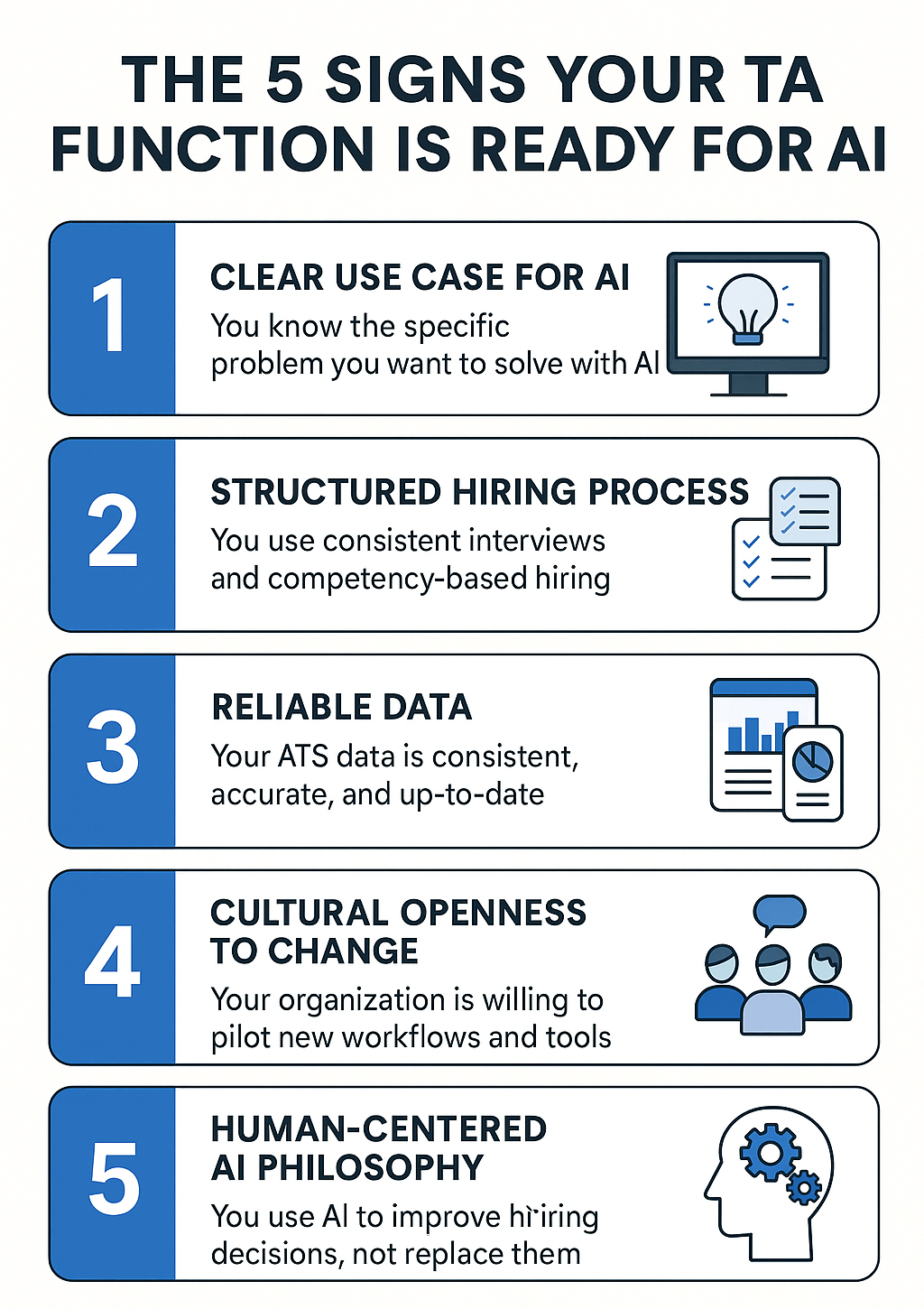
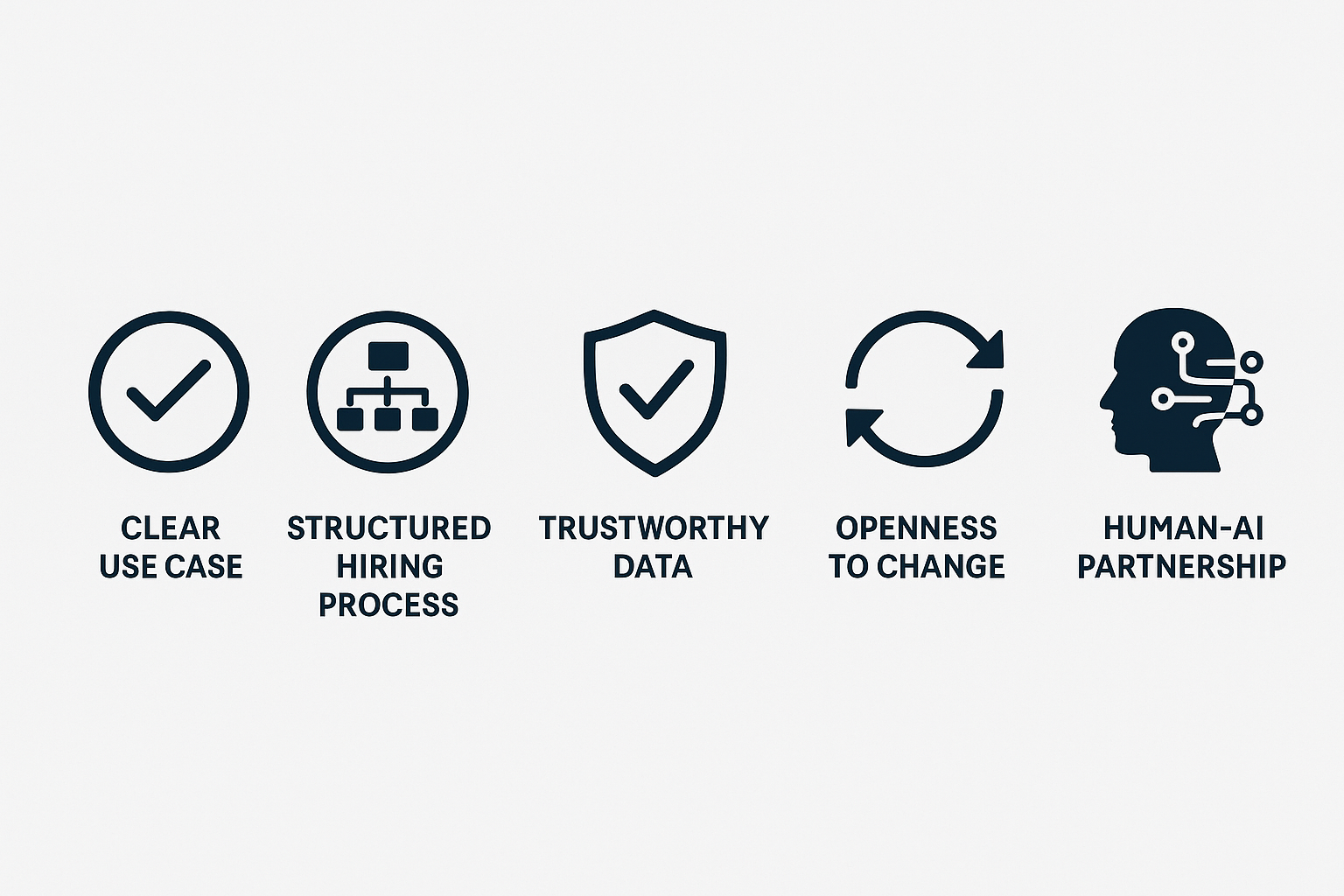
Readiness is not about perfection. It is about direction, predictability, and alignment. Below are the five signs your talent acquisition function is genuinely prepared to benefit from AI in recruitment.

Visual framework showing the five signs a talent acquisition team is ready for AI in recruitment.

How to Know Your TA Team Is Ready for AI in Recruitment

The strongest sign of readiness is conceptual clarity. Teams that see the greatest impact from AI in recruitment can articulate the specific problem they want AI to solve.

Imagine a TA leader evaluating the hiring workflow. If they can say clearly that the bottleneck is resume screening that absorbs hours of recruiter time, or inconsistent interviewer scoring, or slow progression between stages, AI can be applied intentionally.

AI only delivers meaningful ROI when it is aimed at a well-defined problem, a pattern reinforced by recent Gartner research on AI’s impact on HR, which shows that clarity of use case predicts adoption success more than tools or budgets. Teams that can point to a measurable pain point demonstrate the level of strategic maturity needed for AI-enabled recruiting.

High-performing TA teams know this:
AI doesn’t create discipline. It amplifies it.

Why Structured Interviews Are Essential Before AI in Recruitment

A second indicator of readiness is the presence of a structured hiring process. AI cannot compensate for inconsistent human behavior. When interviews vary significantly across interviewers, there is no stable data pattern for AI to learn from.

Picture three interviewers speaking to the same candidate. One asks hypothetical questions. Another improvises. A third focuses heavily on personality. The evaluation becomes subjective and unpredictable.

Now imagine those interviewers using the same competency model, aligned behavioral questions, and a consistent scoring rubric. Their evaluations become more stable and reflective of actual job-relevant behaviors.

AI supports and strengthens this structure. It guides interviewers, reinforces the hiring bar, and reduces subjective drift. But it can only do this when the foundational process already exists.

If your organization is moving toward structured interviews or competency-based hiring, you are building exactly what an AI hiring system needs to be effective.

Data Readiness for AI in Hiring: What Your ATS Must Tell You

A third sign of readiness is data that reflects reality. AI does not need perfect ATS data; it needs trustworthy and consistent data.

Imagine an ATS where one recruiter updates stages rigorously while another rarely moves candidates unless asked. The inconsistency creates misleading signals that weaken AI recommendations.

Now imagine a system where:

  • Stage movement reflects actual progress
  • Feedback includes meaningful content
  • Time-to-fill metrics follow a consistent pattern
  • Tagging is standardized
  • Interview notes provide real insight

This is not perfect data, but it is honest data. And honest data enables AI recruitment tools, predictive hiring tools, and talent intelligence systems to reveal patterns that human teams would otherwise miss.

AI is only as good as the behavioral truth reflected in your systems.

Chart comparing structured interviews to unstructured interviews in AI-ready hiring processes


Cultural Signals Your Organization Is Ready for AI Recruitment Tools

AI adoption is not solely a technical shift. It is a cultural one. Teams ready for AI display openness, curiosity, and willingness to pilot new workflows.

Imagine a recruiter who spends hours coordinating interviews. When given an automated scheduler, they feel an immediate reduction in administrative load. That moment of relief is a cultural signal.

Or imagine hiring managers who acknowledge that interview consistency varies more than it should. Their willingness to use structured guides or interviewer coaching tools indicates readiness for interview intelligence solutions.

Organizations that succeed with AI recruitment tools do not resist new methods. They test, adapt, and iterate. Their desire for better outcomes outweighs their attachment to old habits.

If your team’s mindset leans toward experimentation rather than skepticism, the cultural groundwork for AI is already in place.

Graphic showing key data readiness indicators for applying AI in hiring.

How AI in Recruitment Strengthens Human-Led Hiring Decisions

The final signal of readiness is philosophical alignment. AI cannot replace human judgment in hiring, nor should it. But it can dramatically improve the quality and stability of that judgment.

Imagine an interviewer preparing for a conversation. Instead of entering with uncertainty, they review a brief that highlights the competencies most predictive of success for the role. They still conduct the interview. AI simply sharpens their focus.

Or imagine a hiring manager reviewing candidate feedback that is structured, comparable, and rooted in behavioral criteria. Decision discussions become more grounded, less subjective, and easier to calibrate.

This is what AI does well:

  • Identifies patterns humans overlook
  • Reduces inconsistent scoring
  • Strengthens interviewer confidence
  • Flags bias early
  • Increases decision clarity
  • Supports evidence-based hiring

Organizations that embrace this partnership mindset gain the most value from AI in recruitment.

Illustration showing how AI tools reduce manual recruiter workload.

Comparison Table: Evaluating AI Readiness in Talent Acquisition

Here’s a quick comparison to make it easier:

Readiness IndicatorWhat It Looks LikeWhy It Matters
Clear use caseA specific hiring problem identifiedEnsures targeted AI adoption
Structured interviewsConsistent behavioral evaluationEnables reliable AI insight
Trustworthy dataStable patterns in ATS behaviorSupports predictive analytics
Cultural opennessWillingness to pilot new toolsImproves adoption success
Human-led decisionsAI enhances, not replacesProtects fairness and quality

Once these readiness indicators are visible, teams often explore scalable hiring solutions that blend AI tools with high-quality human expertise.

Icons summarizing clear use case, structured interviews, reliable data, cultural openness, and human-centered AI philosophy.

Why AI in Recruitment Works Only When Your TA Function Is Truly Ready

AI succeeds when the conditions around it are healthy. It thrives in environments where processes are stable, decisions are structured, data reflects reality, and teams are open to improvement.

When these signals align, AI becomes a strategic multiplier. It elevates decision quality, reduces workload, improves candidate flow, and strengthens the consistency of every hiring moment.

Readiness is not about eliminating imperfections. It is about creating the conditions in which AI can reinforce the best of what your hiring team already does.

Build Your AI-Ready Hiring Engine With AMS

AMS helps organizations build the process discipline, behavioral consistency, and data foundations required for successful AI in recruitment. From structured interviewing and recruiter enablement to talent intelligence and predictive hiring tools, we support teams preparing to move from traditional recruiting to AI-enabled talent acquisition.

If your organization is exploring AI adoption or refining your hiring infrastructure, our experts can guide you through each stage of readiness and implementation.

Visit our website to build a hiring function that is future-ready, data-driven, and powered by human judgment strengthened by AI. Reach out to us anytime.

About AMS

AMS powers talent strategies that deliver results, redefining a new era of talent driven by people, process, data and technology.

50M+ candidates assessed annually

2,000+ enterprise clients

40+ years of innovation

Transform your hiring process

AMS offers digital innovation and responsible AI, providing agile talent acquisition solutions and talent consulting services that can scale with your business.

People in a meeting room around a laptop

By AMS

Contact us

Want to drive talent results?

When you’re ready to attract, engage and retain the talent you need to succeed, complete this form to connect with us. Alternatively, if you’re looking to work for us, please go to our Careers section.


    How can we help you?*

    Using AI in HR

    TL;DR

    AI is redefining HR in 2025 with measurable, business-ready impact.
    Here’s what the numbers reveal:

    • 37% of the workforce will be directly influenced by GenAI-driven workflows.
    • 70% of employees engage with AI tools daily, making AI literacy essential in HR processes.
    • AI sourcing and rediscovery deliver 30–50% faster hiring, unlocking speed and pipeline depth.
    • Predictive analytics improves talent planning and boosts retention by 10–20%.
    • Smart automation cuts HR operations workload by 30–40%, improving experience and reducing errors.
    • AI hiring tools lower cost per hire by 20–40%, enabling scalable hiring without budget strain.
    • Companies that integrate governance, transparency and human review build stronger, more competitive talent engines.

    Artificial intelligence is transforming HR faster than any other business function. Not in theory, but in everyday workflows. From high-volume hiring in India to global talent mobility, HR leaders are using AI in HR, AI recruitment tools and talent intelligence platforms to shorten hiring cycles, enhance candidate experience and eliminate costly manual work.

    Whether you are scaling a product team in Bengaluru or stabilising operations in London, AI done right turns HR from a transactional engine into a true business accelerator. Done wrong, it amplifies bias, creates legal exposure and erodes trust across the employee lifecycle.

    This guide brings a grounded, practical view of how to apply AI in HR, where it delivers real 2025 impact and how organisations can use it to build a measurable competitive edge. Let’s find out.

    Why Your HR Function Needs AI Right Now

    HR teams today are under more pressure than ever: hiring demands are rising, recruiter capacity is shrinking, and talent markets are shifting faster than traditional processes can keep up. AI is closing this gap by enabling faster hiring cycles, better quality of hire, lower operational workload, improved fairness, and sharper data-driven decision-making across the employee lifecycle.

    And the numbers from 2025 make the case even clearer.
    Gartner reports that 37% of the workforce will feel the impact of generative AI within the next two to five years. AIHR found that 76% of HR professionals fear they will fall behind if they don’t adopt AI within the next 12–18 months. Hirebee predicts that 70% of employees will interact with AI-powered tools daily by 2025. Meanwhile, KPMG estimates the global HR technology market will reach USD 42.5 billion this year, driven primarily by AI capabilities.

    These insights point to one simple truth: AI in HR is no longer optional. It has become table-stakes for organisations that want to stay competitive in hiring speed, talent quality, and workforce agility.

    Teams already using AI are seeing measurable benefits too. Some organisations report nearly 40% higher reactivation of past candidates, while others experience 25–45% faster time to offer for mid-senior roles. These gains are no longer limited to large enterprises. With more accessible and accurate talent intelligence platforms, even small HR teams can now achieve this level of impact.

    How HR Leaders Are Using AI Today

    AI For Resume Screening

    Traditional resume screening relies on keyword match or manual review. Both approaches miss potential. AI changes this by analysing patterns such as achievement rate, project scale, progression speed, and skills adjacency.

    Example
    A fintech company in Bengaluru reduced manual screening hours by 70 percent after switching to AI scored profiles. Recruiters now validate instead of starting from scratch.

    What improves

    1. Time to shortlist
    2. Diversity of pipeline
    3. Visibility of high potential candidates

    AI For Sourcing And Rediscovery

    Your most valuable candidates often already exist in your ATS. AI rediscovery tools scan past applicants, silver medalists, contractors, and alumni, map their updated skills, and match them to new roles.

    Example
    A global services firm found that 28 percent of their new hires in Q3 came from rediscovered profiles after implementing AI match scoring.

    Why it matters

    1. Cuts reliance on job boards
    2. Reduces agency costs
    3. Boosts candidate quality because the system uses historical interactions

    AI Powered Talent Acquisition And Personalization

    Recruiters often juggle administration, scheduling, follow ups, and reporting. AI can take over these tasks with high accuracy.

    What AI handles

    1. Interview scheduling
    2. Candidate nudges
    3. Email personalization based on work history
    4. Feedback summaries for hiring managers

    Example
    A consumer tech brand reduced recruiter workload by 32 percent by adopting automated scheduling and personalized outreach. This freed recruiters for high impact conversations.


    Predictive Analytics For HR

    Predictive models identify early signs of turnover, performance risk, or skill shortages.

    Use cases

    1. Forecast attrition for critical teams
    2. Model future workforce demand
    3. Predict likelihood of offer acceptance
    4. Estimate hiring needs by region

    Example
    A logistics company used predictive analytics to anticipate seasonal hiring spikes in Pune and Chennai. Their hiring lead time dropped from 26 days to 14 days.


    AI Automation Across HR Operations

    Automation saves both time and cost. Several HR teams now use AI for process flows such as onboarding, training reminders, policy queries, and document collection.

    Savings often include:

    1. About 45 percent reduction in HR service desk tickets
    2. Up to 70 percent reduction in manual onboarding touchpoints
    3. More consistent employee communication across time zones

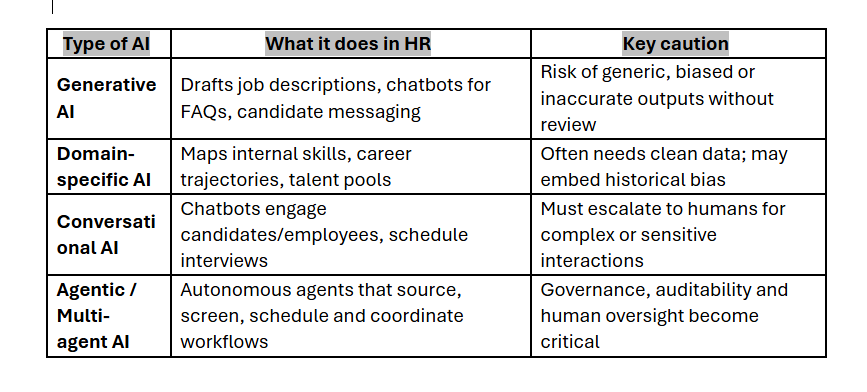
    Understanding the Types of AI in HR

    To select tools wisely, you should know the different flavors of AI and what they deliver.

    AI In HR

    Reports say that 2025 is the year of agentic AI in HR; 47 % of executives believe rethinking talent strategy around AI will deliver ROI. Mercer

    Legal, Security & Governance: The Non-Negotiables

    AI in HR touches hiring, pay, movement, development. These are high-stakes decisions.

    Legal & ethical:

    • Regular bias and fairness audits.
    • Documented decision-logic, explainability.
    • Compliance with region-specific laws (India, EU, UK).

    Security:

    • Encryption, role-based access.
    • Vendor due-diligence: SOC 2, ISO, GDPR.
    • Audit logs for key decisions.

    Governance Framework:

    • Clear accountability matrix (RACI).
    • Human-in-the-loop checkpoints at major decision points.
    • Model lifecycle management: training → validation → monitoring → rollback.

    From the HR trends report: only 12 % of HR departments have integrated GenAI into workflow, underscoring the risk of rushing without governance.

    How to Deploy AI in HR: A Realistic Roadmap

    1. Assess readiness (Week 0). Audit ATS/HRIS data quality, define integration points, review process maturity.

    2. Select pilot (Week 1). Choose a high-value, low-risk use case: e.g., candidate rediscovery or scheduling automation.

    3. Define KPIs. Examples: time-to-first-interview, % of pipeline from rediscovered candidates, cost per hire.

    4. Run pilot (Weeks 2–10). Monitor weekly, include human-review governance, capture learnings.

    5. Audit before scaling (Weeks 8–10). Conduct third-party bias & security review.

    6. Scale intentionally (Months 3–6). Expand workflow coverage, embed training & governance.

    7. Iterate. AI deployment isn’t a one-time project. Continuously review, measure, adapt.

    Organizations that adopt such structured approaches in 2025 are more likely to build sustainable competitive advantage.

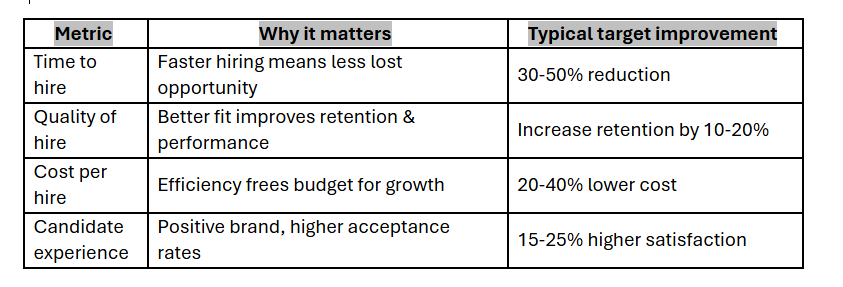
    Measuring ROI: What to Track

    ROI of AI in HR

    With 2025’s data showing 70 %+ of employees interacting daily with AI tools and organisations targeting full integration by year-end, the stakes are clear. Hirebee+1

    Why Organizations Gain a Competitive Edge

    When HR uses AI effectively, the function shifts from cost-centre to strategic driver. Here’s how:

    • Speed = first mover advantage in hiring critical talent.

    • Quality = fewer mis-hires, faster productivity.

    • Insights = proactive workforce planning, not reactive firefighting.

    • Scalability = ability to handle high-volume hiring without proportional cost increase.

    • Differentiation = better candidate / employee experience drives employer brand.

    In 2025, when many organizations still struggle with adoption, being early and disciplined in AI use in HR can create meaningful separation in talent markets.

    Final Thoughts

    Adopting AI in HR is no longer an experiment. It’s now a strategic imperative in 2025. But technology without human judgment, governance and the right processes leads to risk. The winners will be HR teams that combine AI-driven speed and insight with human empathy and control.

    AMS supports organizations through every stage of AI-enabled HR: from data maturity assessment, to pilot selection, to full workforce intelligence deployment. We help you move fast, stay compliant, and build a talent advantage that scales globally.

    Ready to chart your AI-HR pilot?
    Book a complimentary 30-minute diagnostics session with us today.

    About AMS

    AMS powers talent strategies that deliver results, redefining a new era of talent driven by people, process, data and technology.

    50M+ candidates assessed annually

    2,000+ enterprise clients

    40+ years of innovation

    Transform your hiring process

    AMS offers digital innovation and responsible AI, providing agile talent acquisition solutions and talent consulting services that can scale with your business.

    People in a meeting room around a laptop

    By Lynne Gardner

    Lynne has been with AMS for over 20 years, many of which have been spent collaborating closely with blue-chip clients across a range of sectors. Lynne has partnered with many of the world’s largest global investment and retail banks including Morgan Stanley, HSBC and Standard Chartered and supported the evolution of their regional and global RPO models. Lynne has a degree in Business Administration from Aston University. Before joining AMS Lynne spent 10 years in HR and consulting roles with BAA and Hay Management Consultants in a range of roles from business partner to reward and OD.

    Contact us

    Want to drive talent results?

    When you’re ready to attract, engage and retain the talent you need to succeed, complete this form to connect with us. Alternatively, if you’re looking to work for us, please go to our Careers section.


      How can we help you?*

      By AMS

      TLDR: How Global Capability Centers in India Are Redefining Global Operations

      Global Capability Centers in India are transforming from cost-focused support hubs into strategic innovation engines driving global enterprises. With over 1,700 centers employing 1.9 million professionals, India’s GCCs now lead in AI, cloud, engineering, and product innovation. They enable faster go-to-market, hybrid sourcing models, and resilient, future-ready operations. Supported by strong leadership, diverse talent, and digital maturity, India’s GCCs empower organizations to innovate at scale, enhance agility, and achieve sustainable global growth.

      Contact us

      Want to drive talent results?

      When you’re ready to attract, engage and retain the talent you need to succeed, complete this form to connect with us. Alternatively, if you’re looking to work for us, please go to our Careers section.


        How can we help you?*

        By AMS

        TLDR: How Employee Motivation Strategies Drive Engagement and Productivity

        Effective employee motivation strategies help organizations boost engagement, productivity, and retention. By focusing on clear expectations, recognition, career development, communication, autonomy, compensation, inclusion, well-being, goal setting, and feedback, leaders create a culture where teams feel empowered and connected. AMS supports organizations in implementing these strategies to build motivated workforces that achieve long-term success.

        Contact us

        Want to drive talent results?

        When you’re ready to attract, engage and retain the talent you need to succeed, complete this form to connect with us. Alternatively, if you’re looking to work for us, please go to our Careers section.


          How can we help you?*

          By AMS

          TL;DR: Contingent Workforce Solutions in HR

          Fragmented HR systems slow down hiring, increase compliance risks, and limit agility. Contingent Workforce Solutions (CWS) unify ATS, VMS, FMS, and other HR platforms into a connected ecosystem that enables automation, real-time insights, and regulatory compliance. AMS case studies with Delta, Arup, and global banks prove that CWS reduces costs, accelerates hiring, and strengthens workforce resilience—helping enterprises future-proof their talent strategies.

          Contact us

          Want to drive talent results?

          When you’re ready to attract, engage and retain the talent you need to succeed, complete this form to connect with us. Alternatively, if you’re looking to work for us, please go to our Careers section.


            How can we help you?*

            By AMS

            TL;DR: Reducing Costs While Enhancing Agility with Contingent Workforce Solutions

            Contingent workforce solutions go beyond filling gaps, they provide flexibility, cost optimization, and faster access to specialized skills. By combining technology, MSP partnerships, compliance, and predictive insights, organizations can scale talent up or down with agility while reducing costs. AMS helps enterprises design inclusive, future-ready contingent strategies that deliver ROI, improve workforce experience, and turn disruption into competitive advantage.

            Contact us

            Want to drive talent results?

            When you’re ready to attract, engage and retain the talent you need to succeed, complete this form to connect with us. Alternatively, if you’re looking to work for us, please go to our Careers section.


              How can we help you?*