
AI and recruiting have moved past the discussion phase.
When AI entered the market and became the talk of the town, the conversation about AI in recruiting stayed at the level of possibility. Some curiosity built up among HRs with questions like “What could these tools do? What might change?”
That window has closed. AI is now active inside the hiring workflows of most large
AI is now active inside the hiring workflows of most large organizations. The question for talent leaders has shifted from curiosity to execution: how do you deploy it in a way that actually improves hiring quality, holds up under regulatory scrutiny, and keeps skilled recruiters doing the work only they can do?
The data tells a clear story.
- 43% of organizations now use AI for HR tasks, up from 26% in 2024 — a 65% year-over-year increase in adoption. (SHRM, 2025)
- 88% of HR leaders say their organizations have not yet realized significant business value from AI tools. (Gartner, October 2025)
Both figures are true simultaneously. That gap between adoption and realized value is exactly where talent strategy goes wrong.
AMS has seen this dynamic play out across global RPO engagements in more than 120 countries. The differentiator between clients who move the needle and those who stall is rarely the technology itself. It is whether the surrounding hiring infrastructure like job architecture, data governance, and recruiter enablement was redesigned to work with AI rather than around it.
What is AI recruiting and how does it work?
AI recruiting is the use of artificial intelligence technologies, including machine learning, natural language processing, and predictive analytics, to automate, augment, or improve specific steps in the talent acquisition process.
In practice, this includes:
- Automated resume screening and candidate ranking
- AI-assisted job description writing
- Intelligent interview scheduling
- Predictive models that assess a candidate’s likelihood of job performance before a single conversation takes place
How the technology actually works
Resume screening tools use text classification models trained on historical hiring data to rank candidates against defined criteria. Predictive analytics platforms draw on structured and unstructured data, including assessments, performance patterns, and workforce benchmarks, to forecast fit. Conversational AI handles candidate communications through natural language processing, progressing candidates through workflow stages without manual recruiter input at each step.
What distinguishes AI recruiting from earlier ATS automation is its ability to learn and adapt. Traditional keyword matching rules are static. AI models update based on outcome feedback, meaning a well-implemented system improves its matching over time as it learns which hires performed well in which roles.
How is AI changing hiring and recruiting?
AI is changing hiring by compressing the high-volume, low-judgment parts of recruitment and freeing recruiter capacity for the work that requires relationship, context, and decision-making.
The most common applications of AI in recruiting today (SHRM, 2025):
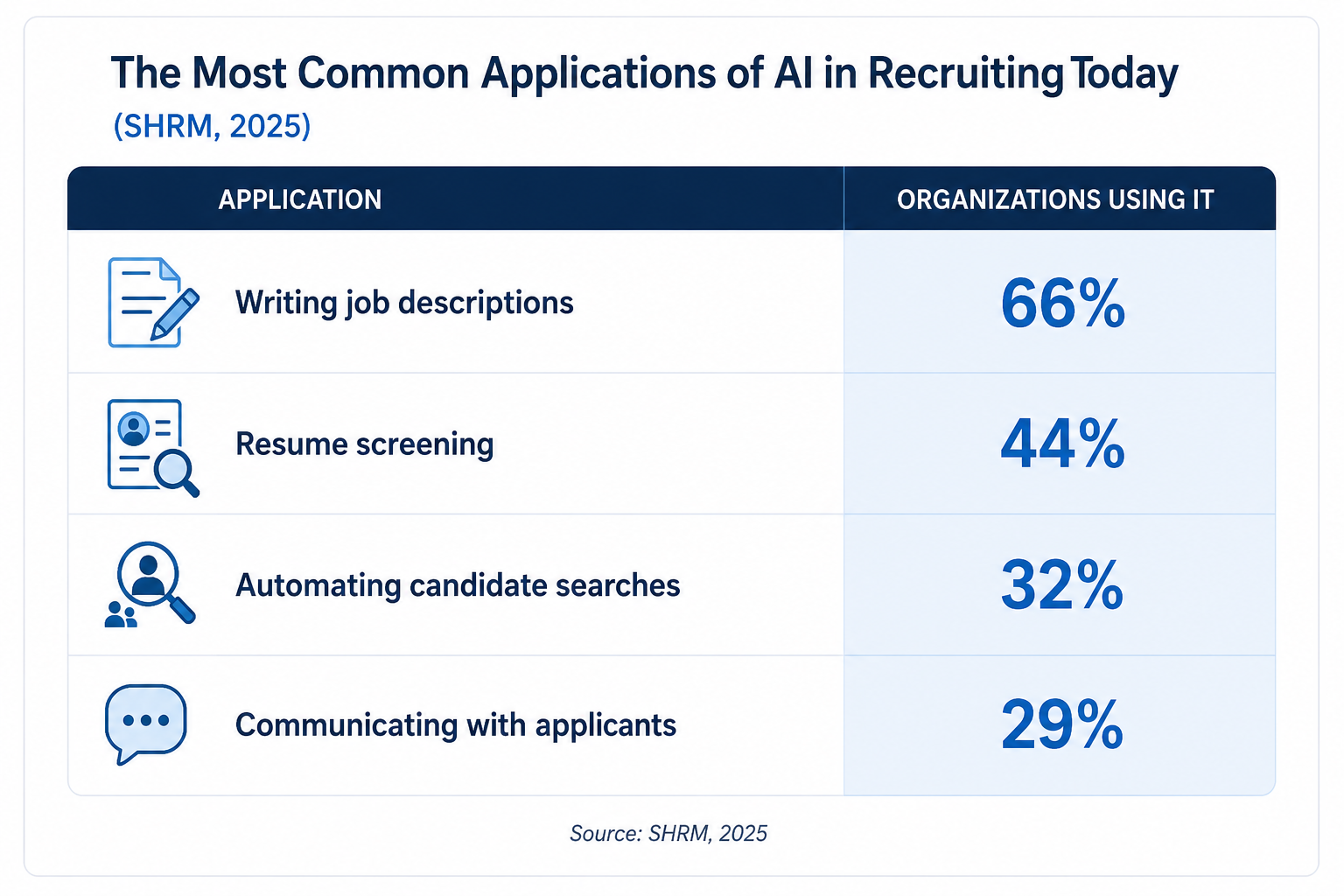
The performance gains are measurable:
- AI screening tools process 75% more applications at the same cost as manual review
- Scheduling automation delivers 60 to 80% reductions in coordinator time
- TA professionals using generative AI report a 20% reduction in weekly workload — roughly one full workday saved per week (LinkedIn, 2025)
At scale, these efficiencies compound fast.
Average cost per hire in the US: $4,700 — up 14% since 2019. Executive hires average $28,329. (SHRM Benchmarking)
Enterprises with 1,000+ employees implementing AI recruitment platforms report average annual savings of $2.3 million. (Deloitte, 2024)
The AI in recruitment market hit $8.16 billion in 2025 and is projected to reach $15.24 billion by 2030. (Grand View Research)
AMS in practice: For Burger King, AMS deployed conversational AI for high-volume recruitment that reduced time-to-hire by 21% and screened and scheduled candidates in under two minutes, compressing what previously took days of manual coordination into a near-instant candidate experience.
“As companies double down on AI, the real differentiator won’t be the technology itself but the human readiness behind it.” — Hannah Yardley, Chief People and Culture Officer, Achievers (December 2025)
Where AI recruiting falls short
Adoption data and market size figures are not the same as proof of outcomes.
Gartner’s finding that 88% of HR leaders have not yet realized significant value from AI is not a contradiction of the efficiency gains discussed above. It is a diagnostic.
One of the most common failure points is treating AI as a standalone technology purchase rather than a change to the entire hiring operating model.
AI screening layered onto a broken sourcing strategy sorts a poor talent pool faster.
AI scheduling within a fragmented recruiter experience saves coordinator time but does little to improve hiring manager responsiveness or offer acceptance rates.
SHRM’s own data highlights the structural challenge. Average cost per hire and time to hire have both increased over the past three years, even as AI adoption has grown. The organizations reporting 70% reductions in time to hire were not necessarily the ones that purchased better software. They redesigned the surrounding process to take full advantage of the technology.
Data quality is another critical factor.
AI models are only as accurate as the information used to train them:
Resume parsing tools achieve approximately 94% accuracy.
Predictive performance models achieve approximately 78% accuracy.
These results are valuable, but they are not infallible and should not replace human judgment at the point of decision-making. If an organization’s historical hiring data contains structural bias, an AI model trained on that data is likely to replicate those patterns rather than eliminate them.
In AMS’s experience, organizations often struggle when AI tools are deployed before job taxonomies are standardized, hiring manager workflows are aligned, or quality-of-hire criteria are clearly defined. Without those foundations in place, faster automation can simply produce faster noise rather than better hiring decisions.
The compliance reality in 2026
As AI becomes more embedded in hiring decisions, compliance is moving from a future consideration to a current business requirement.
Regulations such as New York City’s Local Law 144 and the EU AI Act are introducing stricter requirements around transparency, human oversight, bias mitigation, and accountability for AI-driven hiring decisions. Similar legislation is emerging across other jurisdictions, creating new governance challenges for organizations operating across multiple markets.
This is where responsible AI becomes more than a technology discussion. It is a business imperative. Organizations need confidence that AI systems are fair, explainable, compliant, and aligned with their hiring objectives. Without clear governance frameworks, even well-intentioned AI deployments can create compliance, reputational, and candidate experience risks.
For talent leaders, the focus should not be on adopting AI as quickly as possible. The focus should be on implementing AI responsibly, with the right controls, oversight, and decision-making processes in place.
Explore AMS’s approach to responsible AI in talent acquisition.
How are AI agents used in HR and recruiting?
AI agents represent the next evolution beyond point-solution automation.
Where earlier AI recruiting tools automate individual tasks, such as screening or scheduling, AI agents are designed to orchestrate multi-step workflows with minimal human intervention at each stage.
In a connected workflow, a single AI agent can:
- Receive a job requisition
- Generate a sourcing strategy
- Identify and rank candidates across multiple databases
- Send personalized outreach and respond to replies
- Schedule and confirm interviews
- Surface a shortlist to the hiring manager
Gartner flagged agentic AI in HR as the single biggest inflection point in the 2026 AI recruitment market. 82% of HR leaders plan to deploy agentic AI in HR by mid-year. (Pin Research)
The practical implication: the distinction between “AI tool” and “AI process” is collapsing. Implementation decisions made now on data governance, job architecture, candidate experience, and human oversight will determine whether agentic AI improves hiring outcomes or simply automates a flawed status quo faster.
What responsible AI recruiting actually requires
Organizations generating measurable value from AI in recruiting tend to share a few common characteristics.
1. They keep recruiters at the center of hiring decisions
LinkedIn research shows candidates respond more positively when AI enables faster, better-informed recruiter conversations rather than replacing them. Seventy-five percent of recruiting professionals want humans involved in final hiring decisions. That is not resistance to technology. Relationship building, judgment, and organizational context remain difficult to replicate through automation alone.
2. They invest in implementation quality before scaling
The strongest outcomes typically come from organizations that introduce AI iteratively, establish feedback loops, and refine models using organization-specific data. Adding a new AI solution to an existing ATS environment without addressing data quality, job architecture, or hiring manager behaviors may accelerate processes, but it rarely improves hiring outcomes.
3. They maintain a clear audit trail
Explainability is no longer a best practice. It is a business requirement. When regulators, auditors, or candidates ask how an automated decision was made, organizations need clear and defensible answers. Those who cannot trace how recommendations were generated face both compliance and reputational risk.
The Strategic View
The talent acquisition function is undergoing one of its most significant transformations in decades.
AI is accelerating that change, but adoption alone is not creating competitive advantage. The gap between organizations investing in AI and those generating measurable hiring improvements remains substantial.
For talent leaders, the focus must now shift from experimentation to execution:
- Understand where automation adds value versus where human judgment remains essential
- Get ahead of regulatory requirements that are now active, not emerging
- Evaluate process quality, data, and governance as rigorously as the technology itself
AI and recruiting are now inseparable. How you bring the two together is still a competitive decision.
AI is reshaping recruitment, but technology alone does not create better hiring outcomes. Success depends on how effectively organizations combine automation, human expertise, governance, and workforce strategy. AMS helps enterprises navigate this transformation through Next Generation Talent Acquisition solutions that integrate AI responsibly, improve hiring performance, and deliver measurable business impact at scale.