
Designing a talent-first Contingent Workforce program


Contributors:
Orli Becker
EVP and Managing Director of Contingent Workforce Solutions, AMS
Rebecca Wettemann
CEO and Principal Analyst, Valoir




Today’s contingent workforce programs are designed with suppliers, cost controls, and transactions in mind. But what about the talent? In a skills-scarce, AI-enabled, worker-choice market, a workforce program that focuses on the needs of talent is now a competitive necessity.


Contingent labor now sits at the center of how organizations get work done, not at the edges of the workforce strategy. Across industries, organizations are relying more heavily on external talent to access scarce skills, deliver project-based work, and respond to shifting demand. What was once a flexible resourcing option has become fundamental to business delivery.
This shift brings clear advantages, but it also introduces complexity. As contingent work grows in scale and importance, organizations must balance access to critical skills with cost control, workforce visibility, and increasing regulatory and classification risk.
The forces driving this change are well understood. Skills are scarce and unevenly distributed. Demand is volatile and harder to predict. More workers are choosing flexible, independent ways of working. Project-based and outcome-led models are replacing traditional role-based structures. In this environment, contingent talent is no longer supplementary; it is essential.
The challenge is that most contingent workforce programs were designed for a different world.
Why the traditional model is no longer enough
For many organizations, today’s contingent workforce programs are the product of years of incremental optimization. MSPs, VMS platforms, staffing suppliers, and governance frameworks have delivered important benefits in terms of compliance, consistency, and spend control.
But these models were designed around a narrow definition of value.
Contingent workers are increasingly delivering core business outcomes, not peripheral tasks. Organizations are relying on external talent for specialized skills, program delivery, transformation initiatives, and innovation. At the same time, hiring managers are under pressure to move quickly, adapt to changing priorities, and secure scarce capability in highly competitive markets.
Yet many contingent workforce programs still prioritize supplier management over talent engagement, and compliance over hiring manager experience. The result is friction for hiring managers, for talent acquisition teams, and for the workers themselves.


The current solutions are still addressing yesterday’s problems and not the challenges of today and tomorrow.
Orli Becker, EVP and Managing Director of Contingent Workforce Solutions for AMS.
Where programs are difficult to use, adoption suffers. Where adoption suffers, visibility breaks down. And where visibility breaks down, organizations are exposed not just to inefficiency, but to compliance, classification, and reputational risk.
The issue is not a lack of investment or intent. It is a misalignment between how contingent work is delivered today and how it is managed.


Contingent work is more vital than ever
Recent layoffs in technology and corporate sectors have prompted renewed debate about whether AI will reduce demand for white collar contingent talent. The evidence points otherwise. Even as automation accelerates, organizations continue to depend on contingent workers to fill skills gaps, deliver project-based work, and respond quickly to changing demand.



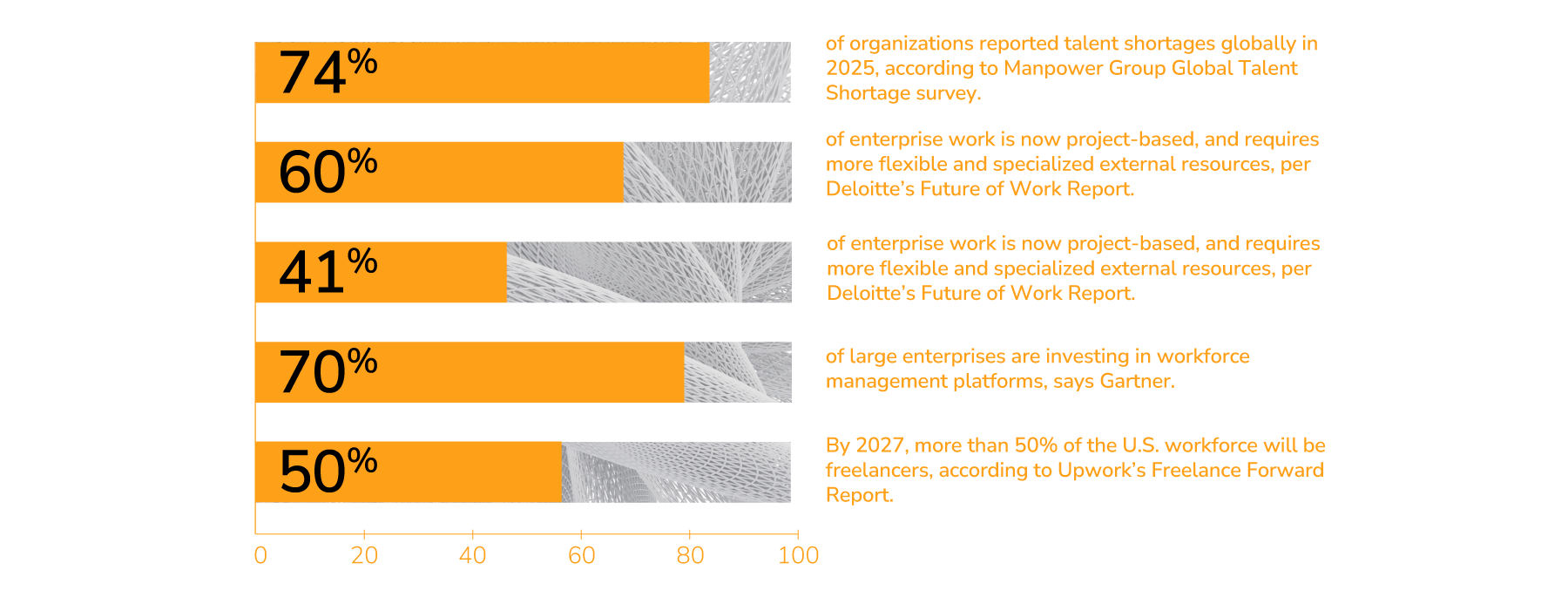
Contingent workers are not what they used to be. In many organizations, contractors are now managing projects, leading programs, and performing key functions that drive business outcomes.
Rebecca Wettemann, CEO and principal analyst of HR market consultancy Valoir.
A pivotal shift toward greater visibility and control
To meet today’s demands, organizations need to rethink the contingent workforce operating model, shifting the focus from managing transactions to managing talent.
Until recently, that misalignment was hard to fix. Most organizations lacked the visibility and insight needed to manage contingent talent in a more holistic way. Data was fragmented. Processes were manual. Understanding skills, performance, and availability across a growing external workforce was difficult at best.

One of the seven pillars of CWM program excellence is a talent-centric ecosystem. By building this talent ecosystem centric model, enterprises can respond rapidly to project demands, reduce vendor dependency, and create agile, skills-based workforce capabilities.
Everest Group, The Future of Contingent Workforce Management
That is changing. AI is now making it possible to see the contingent workforce more clearly and manage it more intentionally. Organizations can move beyond managing transactions and begin to design programs around talent without losing the control and governance they still need.
What is a talent-centric contingent workforce and why it matters?
If contingent labor is now central to how work gets done, then the way it is managed must evolve with it.
A talent-centric contingent workforce program starts from a different premise: that people, not transactions, ultimately drive outcomes. Rather than organizing the program around vendors and requisitions, it is designed around how talent is found, engaged, deployed, and reengaged over time.
In a talent-centric model, success is not measured solely by fill times or supplier performance. It is measured by the organization’s ability to access the right skills when they are needed, with sufficient visibility and control to manage cost, risk, and performance effectively.
This shift does not mean abandoning governance or compliance. Instead, it recognizes that sustainable control comes from programs that people actually use, and from visibility that extends across the entire contingent workforce, not just the parts that flow neatly through legacy systems.
According to Everest Group’s “The Future of Contingent Workforce Management” report, one of the seven pillars of CWM program excellence is a talent-centric ecosystem. Everest Group states that “by building this talent ecosystem centric model, enterprises can respond rapidly to project demands, reduce vendor dependency, and create agile, skills-based workforce capabilities.”
At the heart of a talent-centric contingent workforce program are four core building blocks.
The four building blocks of talent centricity
Diversified talent channels


Talent-centric programs move beyond an overreliance on traditional staffing suppliers. They deliberately broaden access to talent through a mix of sourcing approaches, including direct sourcing, talent communities, specialist marketplaces, and freelancer networks.
By diversifying how talent is accessed, organizations reduce dependency on any single channel, improve reach into niche skill areas, and respond more quickly to changing demand.
A coherent end-to-end talent experience

Talent centricity recognizes that experience matters, for both contingent workers and the hiring managers who engage them.
From attraction and onboarding through to assignment completion and redeployment, talent-centric programs aim to create a joined up, credible experience. This supports stronger engagement, improves rehire rates, and makes the program easier to adopt and use in practice.
Technology that enables, not replaces, human judgement

Technology, particularly AI, plays a critical role in modern contingent workforce management, but in a talent-centric model it is used to enable better decisions, not automate them.
AI and automation can remove friction from administrative tasks, improve visibility, and support insight. But human oversight remains essential, particularly when assessing capability, fit, and risk in short-term or high impact roles. Talent-centric programs are designed with this balance in mind.
Hiring manager and Talent Acquisition adoption by design

Adoption is not an outcome of change management; it is a design requirement.
Talent-centric programs are built around how hiring managers and TA teams actually work. When systems are intuitive, responsive, and aligned with delivery realities, adoption follows and with it, the visibility and control organizations need to manage cost and risk effectively.




Adopting a talent-centric workforce model
Adopting a talent-centric contingent workforce model is not about switching providers or implementing a new platform. It is a shift in mindset.
It requires organizations to look beyond transactions and ask more strategic questions:
- How easily can we access critical skills when demand shifts?
- How visible is our contingent workforce really
- How well does our program support the people who rely on it day to day?
Cost control and compliance remain table stakes. But in a labor market defined by scarcity, volatility, and worker choice, they are no longer enough.
Organizations that succeed will be those that design contingent workforce programs around talent, treating contingent labor not simply as a cost to be managed, but as a capability to be enabled.

People cannot be viewed as cost centers; they’re the driving force behind an organization’s outcomes.
Orli Becker


Navigating such a major shift requires a framework, alignment with internal stakeholders, and possibly support from experts in the field who have helped several organizations achieve similar outcomes. Organizations who act today will be best poised to secure the talent they need and achieve competitive advantage.
AMS Contingent Workforce Solutions helps organizations design and operate talent-centric contingent workforce programs that balance access to critical skills with visibility, compliance, and outcomes.
To explore what a talent-first contingent workforce model could look like for your organization, speak to an AMS expert.
 Built with Shorthand