
QUIZ
Is your TA transformation on track?
See how leading organizations are using AI to transform talent acquisition and drive real business impact
QUIZ
Is your TA transformation on track?
See how leading organizations are using AI to transform talent acquisition and drive real business impact
QUIZ
Is your TA transformation on track?
See how leading organizations are using AI to transform talent acquisition and drive real business impact

QUIZ
Is your TA transformation on track?
See how leading organizations are using AI to transform talent acquisition and drive real business impact

QUIZ
Is your TA transformation on track?
See how leading organizations are using AI to transform talent acquisition and drive real business impact
Direct sourcing has moved from a niche experiment to a mainstream enterprise strategy as contingent work grows and traditional agency models strain under cost and scale pressures. By building and reusing internal talent pools, enterprises are reducing contingent labor costs by 15–40 percent, cutting time-to-hire by up to 60 percent, and gaining greater control over workforce planning. Heading into 2026, direct sourcing is becoming a defining capability for organizations that need speed, continuity, and resilience in how they access external talent.
Enterprise hiring models are under pressure, not because talent has disappeared, but because the way organizations access it hasn’t kept pace with reality.
Industry reports like Forrester project share of contingent and gig workers within the global workforce growing to 50% by 2050, driven by gig economy expansion valued at $646.77 billion. Hiring teams are handling far more applications than they were just a few years ago, without seeing meaningful gains in speed or quality. Cost controls are tighter, expectations are higher, and the margin for inefficiency is shrinking.
That’s why contingent hiring models like direct sourcing have evolved from a niche experiment into a mainstream enterprise strategy.
Organizations that apply automation and AI across recruitment workflows have reduced average hiring time from twelve days to just four. Yet many enterprises are still dependent on fragmented, agency-led models that increase cost, limit visibility, and weaken long-term access to talent.
Direct sourcing offers a different path, one built around ownership rather than transaction.
Direct sourcing isn’t about replacing agencies everywhere. It’s about regaining control where reliance on intermediaries no longer makes sense.
Traditional staffing models work against scale. Each requisition starts from scratch, markups inflate costs, and once an assignment ends, the talent relationship often disappears. As contingent hiring becomes more central to business operations, those inefficiencies compound quickly.
Enterprises adopting direct sourcing are doing so to:
Enterprises with mature direct sourcing programs consistently see measurable gains. Contingent labor costs typically decline by 15–40 percent compared to traditional agency models as third-party markups are reduced and internal talent pools grow. Within the first year, 20–40 percent of repeat roles are often filled from pre-vetted candidates, improving speed and scalability. This reuse drives time-to-hire reductions of up to 60 percent, higher acceptance rates from engaged alumni, and more predictable workforce planning as organizations gain reliable access to proven talent.
At its core, direct sourcing is about ownership.
Enterprises that control their talent relationships can:
The result is a more resilient workforce model: one that can flex quickly without compounding cost, compliance, or delivery risk.
The “rise of direct sourcing” is fundamentally the rise of sophisticated technology that makes complex talent orchestration manageable.
A competitive direct sourcing platform is the central nervous system managing your entire talent ecosystem, from attraction through deployment, performance tracking, and crucial re-engagement for future opportunities.
The table below highlights the platform capabilities enterprises are prioritizing as direct sourcing matures from experimentation to scale. Adoption data shows that AI-powered matching, talent relationship management, and integrated marketplaces are no longer emerging features but core enablers of performance. As usage increases, these capabilities are delivering measurable returns in the form of faster hiring, stronger talent reuse, and lower contingent labor costs, reinforcing why platform choice is becoming a competitive differentiator heading into 2026.
| Platform Feature | 2025 Enterprise Adoption | Projected 2026 ROI |
|---|---|---|
| AI-powered matching & curation | 62% (Forrester) | 35% faster hires |
| Talent CRM & engagement tools | 55% (SIA) | 25% retention boost |
| Integrated gig marketplace | 48% (Deloitte) | 28% cost reduction |
The data highlights a direct link between platform maturity and improved hiring outcomes heading into 2026.

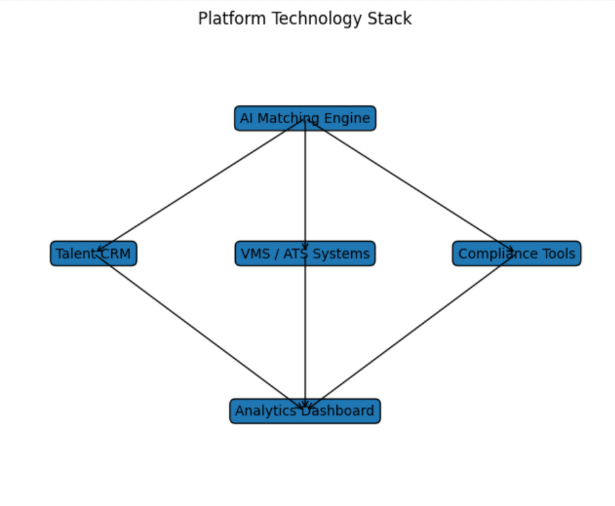
The diagram illustrates how a modern direct sourcing platform functions as an integrated ecosystem rather than a standalone tool. At the core is the AI matching engine, which connects talent data, demand signals, and compliance requirements in real time. This engine draws from the Talent CRM, existing VMS and ATS systems, and compliance tools, ensuring candidates are matched efficiently and responsibly. All activity flows into a centralized analytics dashboard, giving enterprises end-to-end visibility across hiring performance, talent reuse, cost, and risk. Together, these components enable faster decisions, better control, and scalable direct sourcing execution.
Direct sourcing is often discussed alongside new platforms and AI tools, but technology alone is not the story.
Leading direct sourcing programs share a few consistent characteristics:
As 2026 approaches, the most important questions aren’t about features or vendors. They’re about the business outcomes enterprises are trying to achieve:
Enterprises that start answering these questions now will be better positioned to compete for scarce skills as market conditions tighten. For a deeper perspective on how CHROs should be thinking about the external workforce, read this expert insight from Christoph Niebel, Chief Client Officer, Americas at AMS, which explores the critical questions leaders should be asking as workforce models evolve.
Direct sourcing isn’t a silver bullet, and it isn’t universally applicable. But for organizations with recurring contingent demand, it is becoming a defining capability; one that separates reactive hiring from sustainable workforce strategy.
The organizations that move first won’t just hire faster. They’ll hire smarter, with less friction, better insight, and far greater control.
The good news is that direct sourcing is not uncharted territory. AMS has been designing and delivering direct sourcing strategies for nearly three decades, long before it became a mainstream enterprise priority. That depth of experience means organizations can avoid the common pitfalls many are only now encountering, from fragmented ownership to underutilized talent pools. With a proven structure built over 30 years, AMS helps enterprises move faster, reduce risk, and realize measurable outcomes, including 30–40 percent cost savings and up to 50 percent faster fills.
AMS has pioneered enterprise direct sourcing solutions for global leaders. We’ve helped Fortune 500 companies achieve:
We don’t just sell technology. We architect comprehensive contingent workforce strategies tailored to your specific talent challenges.
For organizations ready to move from exploration to execution, AMS offers a Consulting Diagnostic designed to assess and strengthen your external workforce strategy.
This structured engagement evaluates your current contingent workforce program across operating model, sourcing channels, technology, compliance, and spend. The diagnostic combines qualitative and quantitative analysis to identify gaps, risks, and opportunities, and delivers practical recommendations grounded in enterprise benchmarks.
Outcomes typically include:
To learn whether a Consulting Diagnostic is the right next step for your organization, speak with an AMS advisor.
AMS powers talent strategies that deliver results, redefining a new era of talent driven by people, process, data and technology.
AMS offers digital innovation and responsible AI, providing agile talent acquisition solutions and talent consulting services that can scale with your business.
